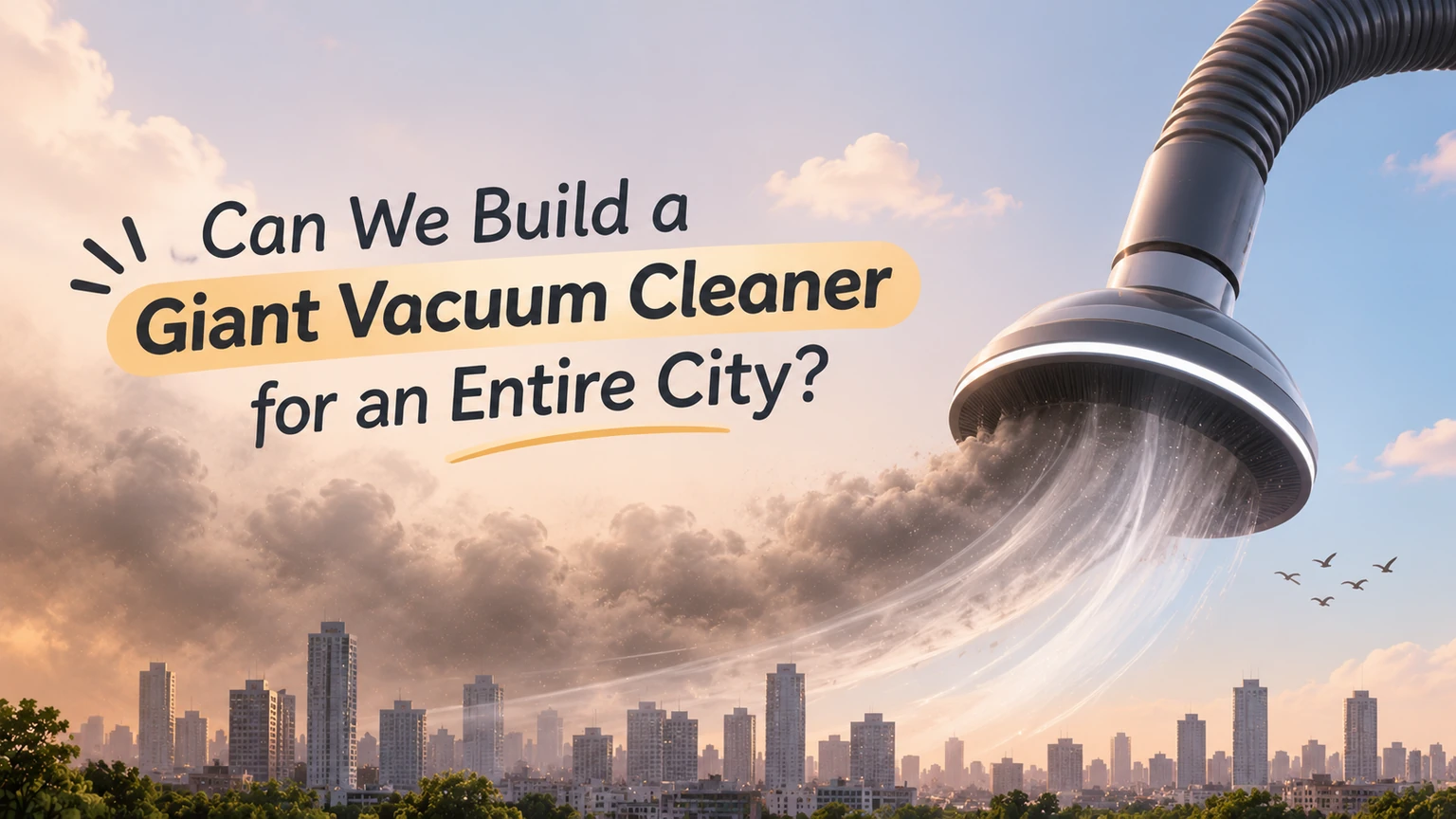
What if the solution to urban air pollution looked less like a policy and more like a giant machine, pulling dirty air in and sending clean air back out?
Imagine standing in the middle of a crowded city. Cars move through traffic, construction dust rises from the roads, factories release emissions, and thousands of people go about their day. Now imagine a giant machine somewhere nearby, quietly drawing in polluted air, filtering out harmful particles and releasing cleaner air.
It sounds like something from a science-fiction film. But the idea is not entirely fictional.
Cities around the world have experimented with large outdoor air purification systems, often called smog towers. Some look like enormous industrial filters. Others use fans, filtration systems or innovative materials to remove pollutants from the surrounding air.
The question is: can we make these machines large enough to clean an entire city?
And more importantly, would they actually work?
1. Why Can't We Just Vacuum the Pollution Away?
The idea seems straightforward. Indoor air purifiers work by drawing air through filters that capture dust, smoke and other particles. Once filtered, cleaner air is released back into the room.
So why not build a much larger version for outdoor spaces?
The problem is the environment in which these machines operate.
A room is a relatively enclosed space. Its air volume is limited, and an air purifier can repeatedly circulate the same air through its filters.
A city is the opposite.
Outdoor air is constantly moving. Wind carries pollution across neighbourhoods, vehicles release new emissions every second, and weather conditions influence how pollutants spread or settle. Pollution also comes from multiple sources, often located far apart.
Even if a machine cleans the air around it, fresh polluted air can quickly move into that space.
In other words, a city is not a room with its windows open. It is a constantly changing atmosphere with no fixed boundaries.
That makes the challenge much bigger than simply building a more powerful vacuum cleaner.
2. The Machines That Are Already Trying
Although a city-sized air purifier remains an ambitious idea, several real-world experiments have explored parts of the concept.
Smog towers in China
One of the best-known experiments took place in Xi'an, China, where a large outdoor air purification tower was developed to reduce particulate pollution.
The system uses air circulation and filtration technology to draw in polluted air and release filtered air. It attracted global attention because it offered a visible, engineering-led response to a problem that affects millions of urban residents.
However, the existence of a large tower does not automatically mean it can clean the surrounding city. Its impact depends on how much air it processes, how far the cleaner air travels, local weather and the amount of pollution entering the area.
Smog towers in India
India has experimented with outdoor air purification too.
Two prominent smog towers were installed in Delhi: one at Connaught Place and another at Anand Vihar. These projects were intended to test whether large filtration systems could reduce particulate pollution in busy urban locations.
The results raised important questions about their practical value.
A government technical assessment found that the Anand Vihar tower's impact was limited, with reductions observed within a relatively small area. Performance also varied with weather, pollution levels and surrounding conditions. The assessment highlighted high energy requirements, maintenance challenges and poor cost-effectiveness compared with other pollution-control measures.
The experiments offered an important lesson: a machine can filter air effectively under controlled conditions without necessarily improving air quality across a neighbourhood, let alone an entire city.
3. The Science Behind the Challenge
To understand why a giant air purifier is difficult to build, consider three major challenges.
The volume of air
A city contains an enormous volume of air, extending far above buildings and across roads, parks and residential areas.
A filtration machine can process only a certain amount of air every hour. Even a powerful system would need to handle an extraordinary volume to make a measurable difference across a large urban area.
And while the machine is cleaning one portion, wind and new emissions keep changing the air around it.
Pollution keeps being produced
Imagine trying to empty a bathtub while the tap is still running.
That is the problem with cleaning polluted outdoor air without reducing the emissions that created the pollution in the first place.
Vehicles continue to burn fuel. Construction sites generate dust. Industries release emissions. Waste burning and other activities add pollutants to the atmosphere.
A purification system would constantly be working against new pollution entering the environment.
The energy and maintenance problem
Large filtration systems need electricity to operate fans and other equipment. Their filters also need regular cleaning or replacement.
The captured material has to be handled and disposed of properly. Otherwise, the pollution has simply been moved from the air into another waste stream.
If a city relies on thousands of energy-intensive machines, the electricity required to run them could create additional environmental costs, depending on how that electricity is generated.
The challenge is not just to build a machine that works. It is to build one that works continuously, affordably and sustainably.
4. Could New Technology Change the Answer?
The idea of outdoor air purification is not limited to traditional filters.
Researchers are exploring several approaches that could help reduce pollution exposure in specific environments.
Advanced filtration systems
High-efficiency filters can capture very small airborne particles. Improving airflow, filter design and energy efficiency could make outdoor purification systems more effective in carefully selected locations.
Photocatalytic materials
Some building materials and coatings are designed to use light to trigger chemical reactions that break down certain pollutants, including nitrogen oxides. Their real-world performance depends on sunlight, surface conditions, pollutant concentration and how much treated surface is exposed to the air.
Green infrastructure
Trees, shrubs and carefully designed green barriers can influence how pollution moves through urban spaces. Vegetation may capture some airborne particles on its surfaces, while well-planned green spaces can also improve the urban environment.
However, planting greenery is not a universal solution either. Poorly designed vegetation in narrow streets can sometimes restrict airflow and allow pollutants to accumulate.
Solar-assisted purification
Solar energy could help reduce the electricity footprint of outdoor air-cleaning systems. Combining renewable energy with efficient filtration may make targeted installations more sustainable, although the complete system still needs to be assessed for cost, maintenance and actual pollution reduction.
A recent 2026 review of outdoor air purification research examined technologies ranging from smog towers to photocatalytic materials and solar-assisted systems. It points to a growing field of experimentation, but also highlights the need for stronger long-term evidence from real-world conditions.
The future may not depend on one giant machine. It may involve several technologies working together in carefully chosen locations.
5. Where Would These Machines Actually Make Sense?
Perhaps the most useful question is not whether we can clean an entire city, but where targeted air purification could make a meaningful difference.
Consider places where large numbers of people spend time in concentrated spaces:
- Hospitals: Areas around entrances and outdoor waiting spaces could benefit from carefully designed exposure-reduction measures.
- Schools: Targeted solutions around playgrounds and school boundaries could be explored, alongside cleaner transport and dust control.
- Busy traffic junctions: Outdoor filtration or vegetation barriers could be tested where pedestrian exposure is high.
- Construction zones: Dust suppression and local containment can address pollution closer to where it is generated.
- Public transport hubs: Stations and enclosed or semi-enclosed waiting areas may offer more practical opportunities for controlled air filtration.
These applications are different from cleaning an entire city. They focus on reducing exposure in places where people need it most.
Any installation would still need independent monitoring to establish whether it makes a meaningful difference.
6. What Would Work Better Than a Giant Vacuum Cleaner?
There is an important distinction between removing pollution after it enters the air and preventing it from entering the atmosphere in the first place.
The second approach is generally more effective at an urban scale.
Instead of relying on thousands of machines to filter polluted air, cities can work on reducing emissions at their sources:
- Improve public transport and make walking and cycling safer.
- Control road dust through better road maintenance and construction practices.
- Enforce industrial emission standards.
- Reduce open waste burning.
- Encourage cleaner fuels and technologies.
- Expand urban green spaces without compromising ventilation.
- Monitor air quality at neighbourhood level to identify pollution hotspots.
These measures may not look as futuristic as a giant vacuum cleaner, but they address the problem before it spreads.
And unlike a single tower, their benefits can extend across entire neighbourhoods and cities.
7. So, Can We Build a Giant Vacuum Cleaner for an Entire City?
Technically, we can build machines that pull in polluted air and filter out certain pollutants. We already have.
But building a machine that can continuously clean the air across an entire city is a very different challenge. The atmosphere is too large, too dynamic and too constantly replenished by emissions for conventional filtration towers to serve as a standalone solution.
That does not mean outdoor air purification has no role. Targeted systems, better building design, green infrastructure and emerging technologies could all contribute to reducing exposure in specific places.
But the bigger opportunity lies in combining innovation with prevention.
Perhaps the future of clean air will not be one enormous machine sitting above a city. Perhaps it will be a city designed so that fewer pollutants enter the air in the first place.
Because the most effective way to clean the air may be to stop making it dirty.
The most effective way to clean the air may be to stop making it dirty. See where your city's air stands today.
Check Your City's AQI