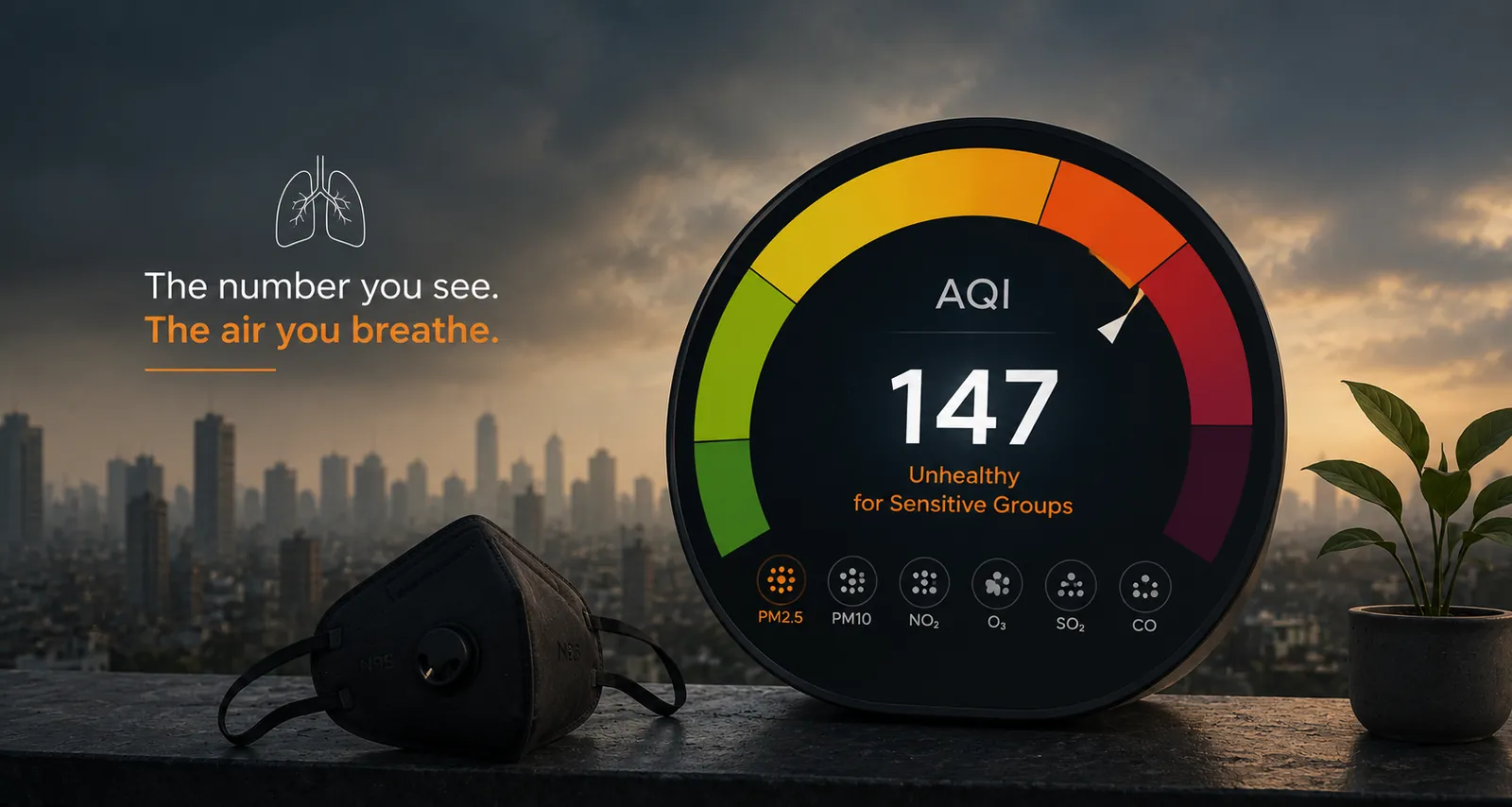
The instinct makes sense: when the AQI climbs, you stay inside and close the windows. But for many Indian homes, closing the windows doesn't mean breathing clean air – it can mean breathing concentrated indoor air that is worse.
The instinct makes sense: when the air outside turns grey and the AQI climbs, you stay inside. Close the windows. Turn on the AC. Wait it out. But here's the uncomfortable data point that most people don't factor in: for many Indian homes, closing the windows doesn't mean breathing clean air. It might mean breathing concentrated indoor air that's worse.
Indoor air quality is the air quality story that hasn't found its mainstream audience yet. We track outdoor AQI. We frown at hazy skylines. But we have almost no reliable data on what is happening to the air in our living rooms, bedrooms, and kitchens – where we spend the vast majority of our time.
Research consistently shows that indoor air can be 2-5x more polluted than outdoor air, even in cities with significant outdoor pollution challenges. Understanding why is the first step toward fixing it.
Source 1: Cooking
The kitchen is the most significant source of indoor air pollution in Indian homes, particularly in kitchens that use gas stoves, biomass, or kerosene.
LPG combustion, even when burning cleanly, generates nitrogen dioxide, carbon monoxide, and fine particles. Gas cooking on a high flame in an unventilated kitchen can temporarily push PM2.5 readings to levels that would be classified as "unhealthy" outdoors. Adding spices to hot oil, producing smoke from a tawa or kadai, or pressure cooking on high heat all generate measurable PM2.5.
In homes without kitchen exhaust fans or windows, common in many mid-density urban housing types, this pollution accumulates. It dissipates slowly and affects the rest of the home.
Source 2: Outdoor Air Infiltration
When outdoor AQI is high, outdoor particles infiltrate indoor spaces through gaps around doors, windows, and ventilation openings. The rate of infiltration depends on building tightness, but in typical Indian construction, which is not airtight by design, outdoor particles can constitute 40-70% of indoor PM2.5 on bad days.
Closing windows reduces but does not eliminate this infiltration. An AC unit on recirculation mode, which pulls no outside air, does better – but only if its filters are regularly maintained. A clogged AC filter can itself become a source of particulate release.
Source 3: Household Products
Aerosol sprays, cleaning agents, synthetic air fresheners, certain candles, and incense sticks are all sources of volatile organic compounds (VOCs) and sometimes particulate matter in indoor air.
Agarbatti (incense sticks), commonly used in Indian homes, are among the most significant indoor particle sources documented in Indian-context research. Studies measuring PM2.5 in rooms with burning agarbatti show spikes that can exceed 200–300 µg/m³ – far above outdoor AQI on typical days.
This isn't an argument against cultural practices. It's an argument for ventilation: if incense is burning, a window should be open.
Source 4: Construction and Renovation
Urban Indian households undergo frequent renovation, and new construction in adjoining flats, civil work, plastering, and painting are near-constant in dense residential complexes. Construction dust contains silica and other fine particles that are health-relevant and can persist in indoor air for days after work stops.
What Actually Helps
Air purifiers with HEPA filtration are effective at reducing PM2.5 in enclosed rooms, provided they are correctly sized for the room volume and run consistently. A HEPA purifier in a 200 sq ft bedroom running overnight can reduce PM2.5 by 70-85% compared to an unfiltered room on a high-AQI day. This is the single highest-impact hardware intervention for indoor air quality.
Kitchen exhaust fans, properly used – actually turned on during cooking, not decoratively installed – reduce cooking-generated PM2.5 substantially.
CO₂ monitoring is underrated as an indoor air quality tool. High CO₂ levels (above 1000 ppm) indicate insufficient ventilation, and ventilation is the mechanism through which many indoor pollutants are cleared. A cheap CO₂ monitor tells you when to open a window.
Regular AC filter maintenance – cleaning or replacing filters every 1–3 months depending on use intensity – maintains the air handling efficiency of your HVAC and prevents filters from re-releasing captured particles.
The Data You Don't Have (Yet)
One challenge with indoor air quality in India is the lack of consumer-grade, accessible monitoring. Unlike outdoor AQI, which is tracked by government monitoring stations and accessible through dashboards, indoor air quality data for most homes simply doesn't exist.
Wearable and portable AQI sensors are beginning to close this gap. Understanding what your indoor air looks like, not just your city's outdoor AQI, is the next frontier for personal environmental health.
Your outdoor AQI is the starting point, not the whole picture. Check today's live readings for your city, then decide: is now a good time to ventilate?
See Today's Clean Hours