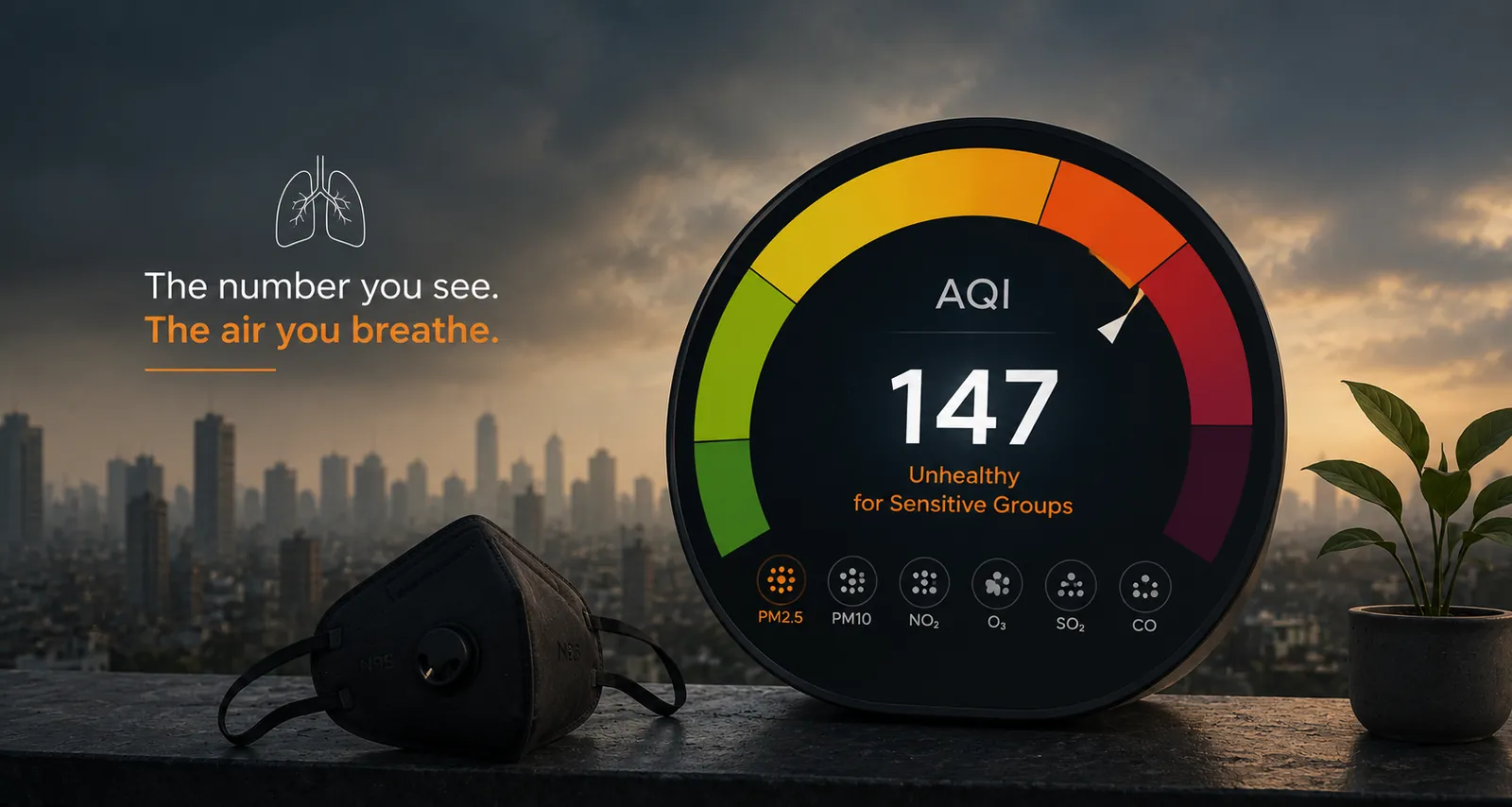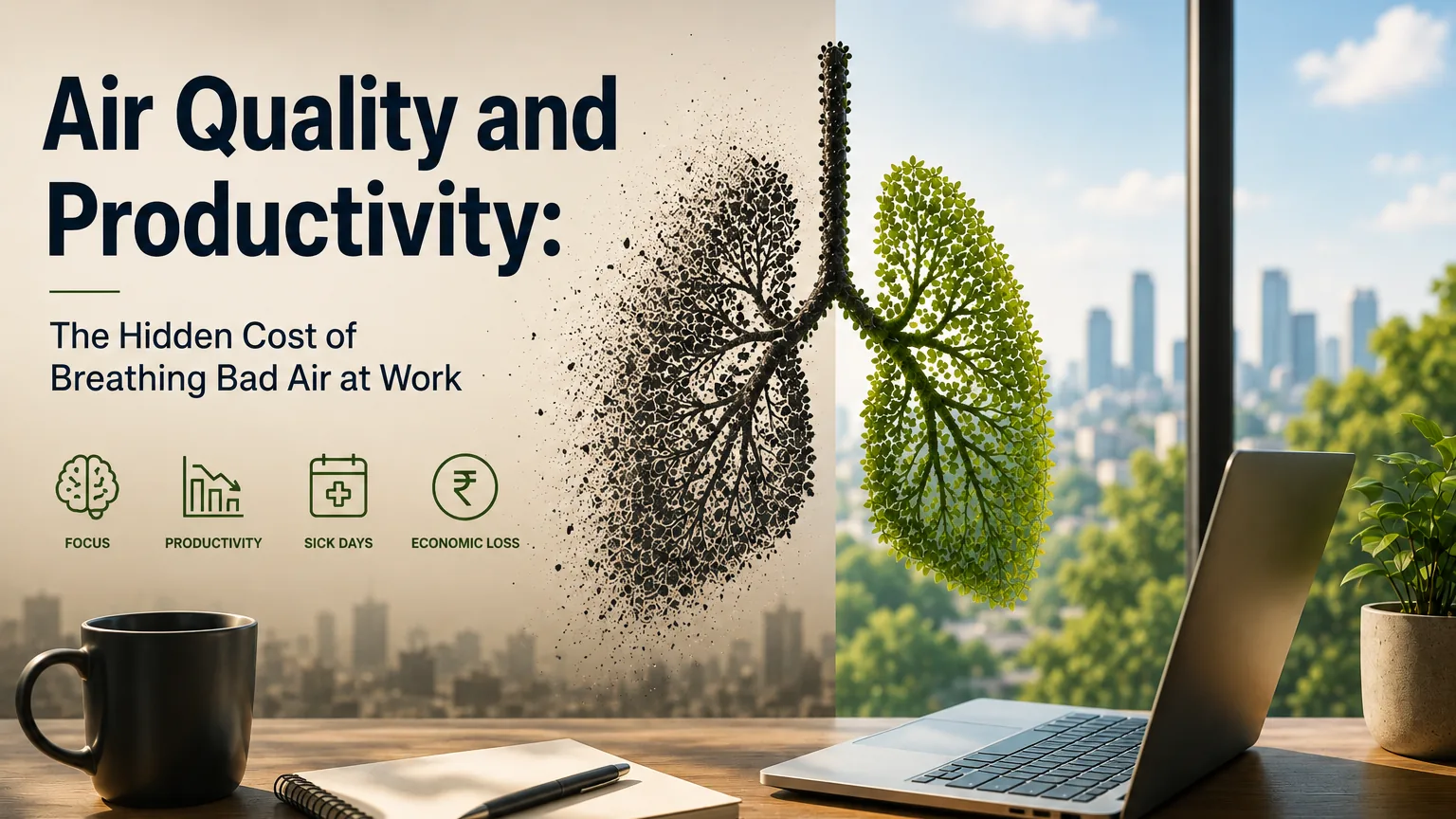
You've probably blamed a slow workday on bad sleep, too much coffee, or the quarterly review looming on your calendar. But there's another variable almost no one factors in — the air you're breathing right now.
The connection between air quality and physical health is well established. Particulate matter damages lung tissue, exacerbates asthma, and contributes to cardiovascular disease. That much is mainstream.
What's less widely understood — and significantly more unsettling for anyone trying to do knowledge work — is air pollution's effect on the brain.
What the Research Shows
A series of studies conducted over the past decade have demonstrated measurable links between PM2.5 exposure and cognitive performance. One of the most cited findings comes from research published in Proceedings of the National Academy of Sciences, which tracked language and arithmetic test scores in China against local pollution data. The results showed that people in high-pollution areas had meaningfully lower verbal scores, and that the effect was larger for older individuals and for men.
A Harvard School of Public Health study found that workers in environments with lower indoor CO₂ and pollutant levels scored significantly higher on cognitive function tests compared with those in conventional office environments. The improvements were most notable in areas like crisis response, strategy, and information usage.
A separate line of research has connected bad outdoor air days with reduced economic productivity — measured not just by sick days, but by the actual output of workers on high-pollution days compared with low-pollution days.
The Indoor Air Problem
Here's the part that most people miss: for office workers and urban dwellers, indoor air quality is often where the real exposure happens.
We spend roughly 90% of our time indoors. Indoor air can carry the same PM2.5, NO₂, and VOC levels as outdoor air — and in some cases higher, because pollutants concentrate in enclosed spaces without adequate ventilation. Add household products, printer cartridges, cooking fumes, and mould, and indoor air quality becomes a legitimate occupational health issue.
In cities like Delhi, Mumbai, and Bangalore, where outdoor AQI frequently crosses unhealthy thresholds, the instinct is to stay inside. That instinct is broadly correct — but only if the indoor environment is actively managed. An unventilated room in a high-pollution city with open windows, or a poorly maintained AC unit with a clogged filter, can trap and concentrate the pollutants that came in with the outdoor air.
The Economic Calculation
This is where data storytelling gets interesting. Think about what "reduced productivity" means at scale.
India loses an estimated $150 billion or more annually to health costs and lost productivity related to air pollution, according to various environmental economics estimates. The figure varies by methodology, but every credible analysis points in the same direction: dirty air is expensive.
Now scale it down to an individual worker — say, someone in Gurugram, where AQI frequently crosses 200 in winter months. The cumulative cognitive load of breathing particulate-heavy air across an entire winter season is not nothing. Fatigue, headaches, reduced concentration, and higher sick leave rates are all documented effects of chronic PM2.5 exposure.
What You Can Actually Do
The goal of this article isn't to make you anxious about the air in your office. It's to make the case that air quality is a legitimate input variable in how you design your workspace and your workday.
Practical levers include:
- Monitor before you act. Use a real-time AQI dashboard to understand when outdoor air is good enough to open windows versus when to seal up. The patterns in your city are more predictable than you would think once you start tracking them.
- Time outdoor activity strategically. If you commute by bicycle, run outdoors, or have a standing desk near a window, knowing your city’s typical hourly AQI profile lets you schedule exposure intelligently. Early mornings often have better air in Indian cities, before traffic builds.
- Invest in indoor air quality at your workspace. A HEPA air purifier in a home office is not a luxury item if it measurably reduces your PM2.5 exposure during a 150 AQI day.
- Advocate at the office level. Building managers have more control over HVAC filtration quality than most employees realise. A conversation about upgrading to MERV-13 filters costs almost nothing to initiate.
The Bigger Point
Air quality is infrastructure. Not just for lungs, but for output, for thought, for the economy. The cities and companies that take it seriously are making a bet on human capital — and that bet has historically paid off.
The data is on the dashboard. Check what your city is breathing today.
Turn the hidden impact into a personal estimate. Use the pollution cost calculator to explore how poor air can affect productivity, health spending, and lost days.
Estimate Pollution Cost