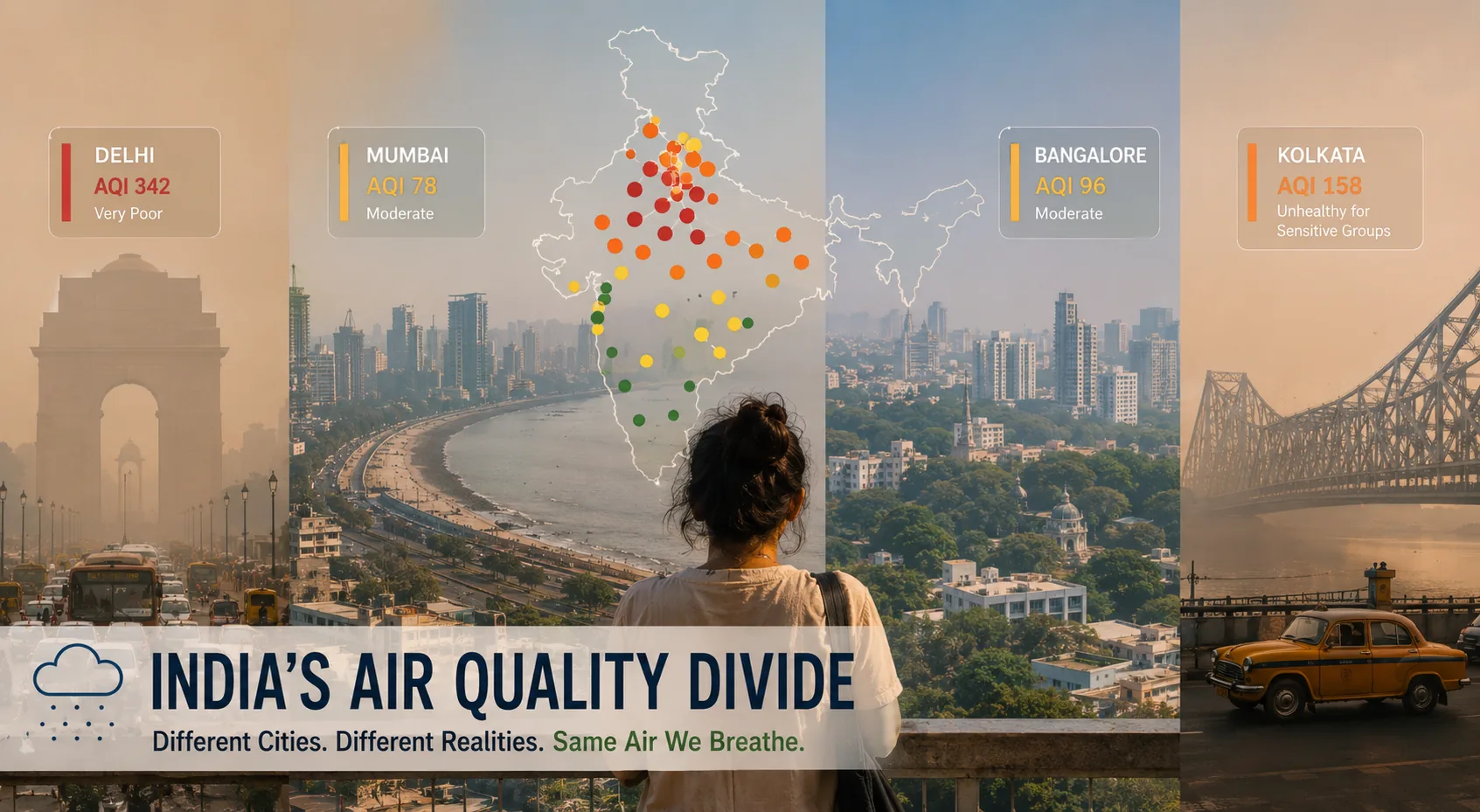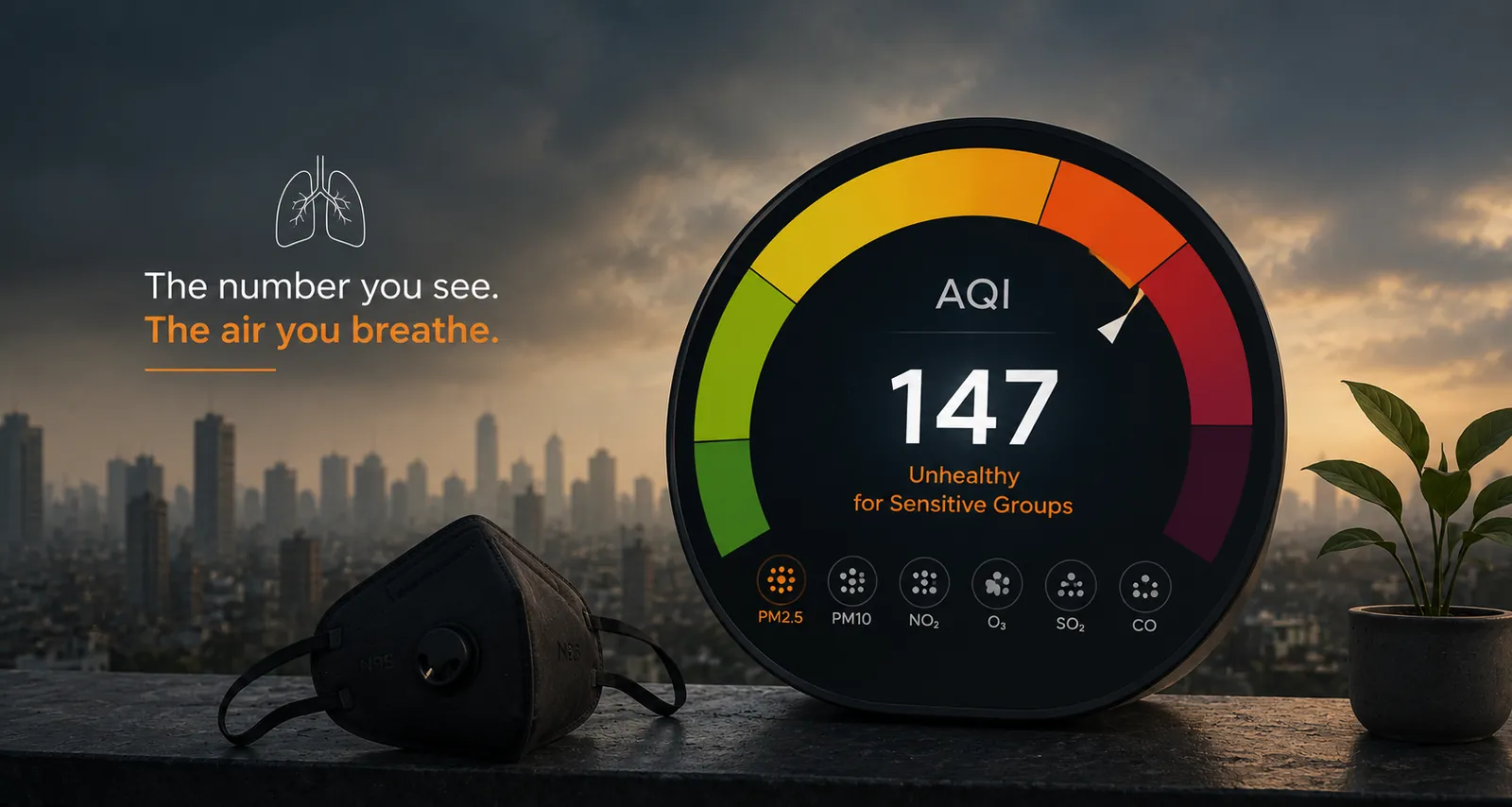
You've seen the number — 147, 312, 78 — on a weather app or a headline about Delhi. But do you actually know what it means for what's happening inside your lungs right now? Most people don't, and it's not their fault.
You've seen the number. Maybe on a weather app, maybe on the dashboard, maybe in a headline about Delhi. 147. 312. 78. But here's the honest question: do you know what any of those numbers actually mean for what's happening inside your lungs right now?
Most people don't. And it's not their fault - the AQI system is simultaneously the world's most important environmental number and one of the most poorly communicated.
What AQI Actually Is
The Air Quality Index is not a single measurement. It's a translation.
Multiple air pollutants - PM2.5, PM10, ozone, nitrogen dioxide, sulphur dioxide, and carbon monoxide - are each measured in their own units (micrograms per cubic metre, parts per billion, etc.). These different measurements are each converted into a standardised 0-500 scale using concentration breakpoints. The highest single-pollutant score becomes the composite AQI.
What this means practically: an AQI of 150 could be driven by PM2.5, or by ozone, or by NO₂. The headline number looks the same, but the health implications and the sources are different. This is why good dashboards show you the individual pollutant breakdown, not just the aggregate number.
The Six Categories - What Each One Actually Means
Air quality is satisfactory. Sensitive individuals (those with pre-existing respiratory or heart conditions) can exercise outdoors freely. For healthy adults, no restrictions needed.
Acceptable air quality for most people. Unusually sensitive individuals may experience minor effects from ozone. For the vast majority of healthy people, no noticeable impact.
This is where the language of caution begins. People with asthma, older adults, and children should consider reducing prolonged outdoor exertion. Healthy adults are generally still unaffected. This range covers a large portion of India's "average" days in major cities.
Everyone begins to experience health effects. Active individuals, children, and those with respiratory conditions should limit outdoor activity. Delhi regularly exceeds this threshold during October-January.
Health alert: everyone may experience serious health effects. This is the range where N95 masks provide meaningful protection. Outdoor exercise should be avoided.
Emergency conditions. The entire population is likely to experience serious health effects. On these days - which occur in Delhi and other northern Indian cities during peak pollution episodes - staying indoors with air filtration is not excessive caution. It's the appropriate response.
The Misconception: "It's Not That Bad Today"
Here's a critical insight the raw number hides: cumulative exposure matters more than any single day.
An AQI of 160 for one afternoon is not the same as an AQI of 160 every day for three months. The body has some capacity to recover from acute exposures. It does not have the same capacity when the exposure is continuous and the recovery window never comes.
This is why annual average PM2.5 exposure - not just peak episodes - is the metric epidemiologists use to model long-term health outcomes. If your city's annual average PM2.5 is above 15 µg/m³ (the revised WHO guideline), that represents a chronic health burden, regardless of how many individual days look "moderate."
PM2.5 vs AQI: The Number That Matters More
PM2.5 - fine particles smaller than 2.5 micrometres - is the single most health-relevant pollutant in the Indian context. These particles are small enough to penetrate deep into lung tissue and enter the bloodstream.
The WHO annual guideline for PM2.5 is 5 µg/m³. The previous guideline was 10 µg/m³. Most Indian cities average 30-90 µg/m³ annually. Delhi averages significantly above that.
When you check the dashboard and see the PM2.5 value alongside the AQI, the PM2.5 number gives you the most direct information about what your lungs are actually encountering.
One More Myth: "Masks Don't Work"
N95 respirators - when correctly worn and fitted - filter out 95% of particles 0.3 microns and above. Since PM2.5 sits between 0.1 and 2.5 microns, a properly worn N95 provides genuine protection on high-AQI days.
Surgical masks are not equivalent. Cloth masks are not equivalent. The protection is largely in fit and filtration grade, which is why the mask you wear on a 300 AQI day matters.
Stop guessing. Find your city's live AQI page, then use the current reading and pollutant conditions to make a better-informed decision about your day.
Check Your AQI Now