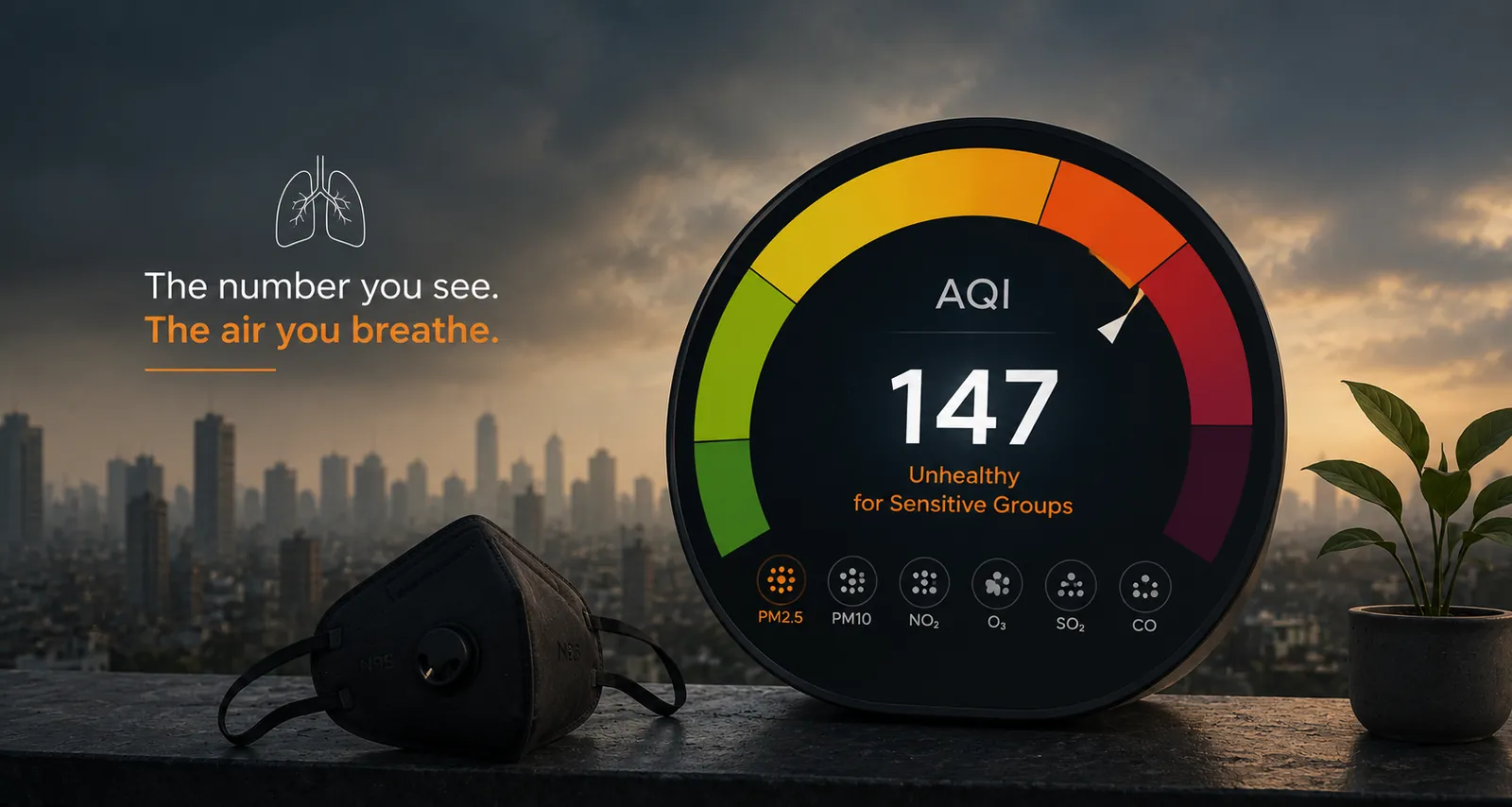
Children breathe roughly 50% more air per kilogram of body weight than adults, and their lungs are still forming. In a city where the AQI regularly crosses 200, that is a daily calculation every parent is making — whether they realize it or not.
Children breathe approximately 50% more air per unit of body weight than adults do. Their respiratory and immune systems are still developing. Their lungs are growing. In a city where the AQI regularly exceeds 200, those are not abstract facts – they are a daily calculation every parent is making, whether they realize it or not.
The conversation about air pollution and health in India is often framed around adults – commuters, outdoor workers, the elderly. Children are discussed less, perhaps because the harms are harder to see in the short term. A child who has grown up breathing polluted air does not know what clean air feels like. There is no before-and-after comparison for them to notice.
But the research is unambiguous: early childhood exposure to particulate matter has lasting effects on lung development, cognitive function, and long-term health outcomes.
Why Children Are More Vulnerable
Three biological factors make children disproportionately susceptible to air pollution:
- Their breathing rate is higher. A child at rest breathes more air per kilogram of body weight than an adult, so every hour spent outdoors on a high-AQI day means inhaling more pollutants relative to body size.
- Their lungs are still forming. The critical window of lung development runs from birth through adolescence. Chronic exposure to fine particulate matter during this window has been linked to reduced lung capacity — a deficit that does not necessarily reverse when the exposure ends.
- Their immune and detoxification systems are less developed. Adults have more mature mechanisms for neutralising the oxidative stress that pollutants trigger in lung tissue. Children absorb the damage more directly.
What the Research Indicates
Multiple longitudinal studies in China, Europe, the US, and increasingly in South Asian contexts point the same way. Children in high-pollution areas show lower lung function scores, higher rates of asthma and respiratory infections, and — in several studies — measurably lower cognitive test scores compared with peers in cleaner areas.
The cognitive angle deserves particular attention. A review of studies across multiple countries found that PM2.5 and NO₂ exposure in early childhood was associated with reduced verbal and non-verbal intelligence scores. The researchers framed pollution not just as a health hazard but as an equity issue: children in poorer, more polluted neighbourhoods face an environmental cognitive disadvantage on top of their socioeconomic ones.
In Indian cities, where the poorest families often live near industrial areas, arterial roads, or open burning sites, that compound vulnerability is very real.
The School Day Problem
The average Indian child spends six to eight hours at school. Many schools have playgrounds facing major roads or sit in areas with high traffic density. Outdoor PT classes, sports periods, and the commute itself are all periods of heightened exposure — and precisely the activities that produce deep, rapid breathing, maximising pollutant intake.
Some schools in Delhi and other high-AQI cities have introduced air purifiers in classrooms, and a few have made real-time AQI monitoring part of their outdoor activity policy. These are the right instincts. But adoption is still patchy and largely driven by individual school decisions rather than systemic policy.
Practical Guidance for Parents
Awareness without action is frustrating. Here are evidence-aligned steps parents can take:
- Check the AQI before school drop-off. If the real-time reading at your location exceeds 150, reconsider extended outdoor activity for the day. The good window in most Indian cities is early morning, before traffic peaks.
- Invest in indoor filtration. A HEPA air purifier running overnight in a child’s bedroom cuts cumulative exposure across the 8–10 hours spent sleeping — a significant share of total daily exposure time.
- Teach children to notice the air. Children who understand that hazy skies and burning eyes are signals worth paying attention to grow into adults who make better exposure decisions. The AQI dashboard is not just for adults.
- Advocate for school-level policy. Parent-teacher associations can raise the question of real-time AQI monitoring and outdoor activity thresholds. Starting that conversation costs nothing.
The Long View
There is a statistic worth sitting with: the generation of children born in Delhi NCR over the last decade will, on average, have spent more time breathing air above the WHO annual PM2.5 guideline than any previous generation — unless something changes structurally.
That is not a reason for despair. It is a reason to track, to advocate, to make different individual decisions, and to expect more from urban policy. The dashboard tells you what today’s air looks like. What comes next is a decision.
Find out what your child may be breathing today. Browse live AQI pages for Indian and global cities before planning school travel or outdoor play.
Find Your City AQI