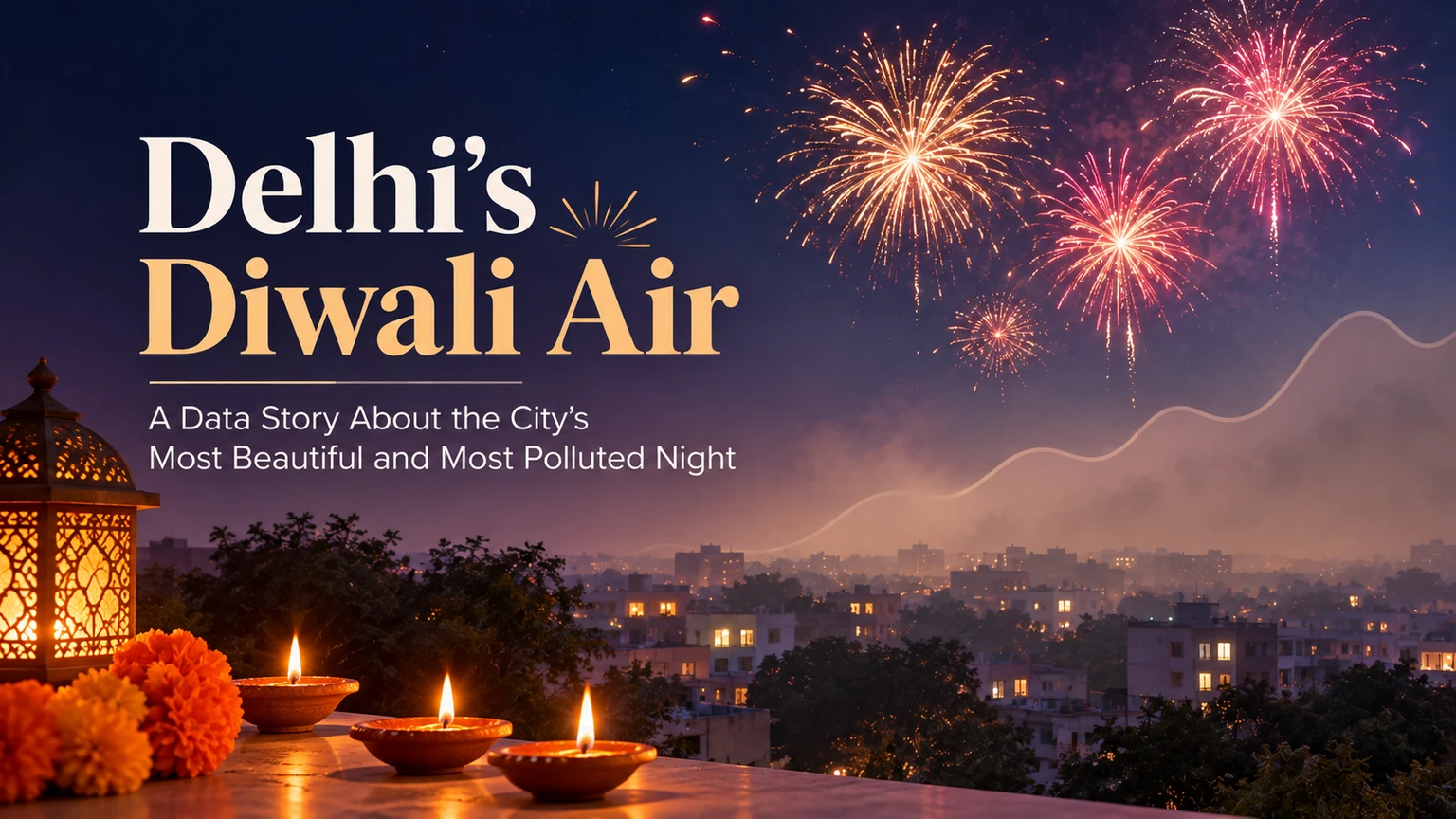
There is a window of roughly thirty minutes on Diwali night – after the first round of firecrackers and before the haze fully sets in – when Delhi looks like no other city on Earth. Lights everywhere. The smell of gunpowder and marigolds. Rooftops full of people. And then the air turns.
This article isn't about whether people should or shouldn't burst firecrackers. That conversation has its own weight and its own complexity. This is about what the data shows, what actually happens to Delhi's atmosphere on and around Diwali, because understanding the mechanism is the prerequisite for making informed personal choices.
The Baseline Problem
Diwali falls in late October or early November. In Delhi, this is already deep inside the winter pollution season. By Diwali, the city's AQI is typically already running at 200-250 as a baseline, elevated by the combination of meteorological trapping, farm fires from Punjab and Haryana, and local sources ramping up as temperatures drop.
This matters because it means Diwali's fireworks emissions don't land on a clean atmosphere. They land on an atmosphere that is already compromised.
What Happens During Diwali Night
In the two to four hours of peak firecracker activity on Diwali night, Delhi's PM2.5 concentrations spike dramatically. Historical data from monitoring stations across Delhi shows typical Diwali night readings of 600–900 µg/m³ in residential areas, with some stations recording values above 1,000 µg/m³.
The AQI scale's maximum is 500. The numbers on Diwali night exceed this ceiling.
The composition of Diwali air is distinct from typical winter pollution. Firecrackers release not just PM2.5 but a specific cocktail of heavy metals – barium, strontium, potassium, aluminum – that accompany the different colored explosions. These metals are respiratory irritants at the concentrations found in ambient air during festival peaks.
How Long Does It Last?
This is where the meteorology takes over again. If Diwali coincides with windy conditions, the spike can clear within 12–24 hours. If it coincides with a calm, inversion-dominated night, which is common in the November weather window, the pollution can persist for 48-72 hours at elevated levels before returning to the (already high) winter baseline.
The post-Diwali mornings are often the worst for residents who stayed indoors during the night: the overnight accumulation under an inversion creates early morning conditions that register among the year's worst.
The Green Cracker Story
The Supreme Court of India has periodically mandated the use of "green crackers" – firecrackers formulated to reduce toxic metal and particulate emissions. The efficacy of these crackers has been debated, and enforcement of the mandate has been inconsistent.
What the research suggests is that green crackers do produce meaningfully lower emissions per unit compared to conventional crackers, but that at the volumes typically burned in a city of Delhi's density, the aggregate load is still substantial. Composition improvements don't automatically translate to air quality improvements if total volume remains unchanged.
The Regional Dimension
Diwali's air quality impact is not unique to Delhi. Mumbai, Bangalore, Kolkata, Chennai, and virtually every Indian city with dense residential settlement sees significant AQI spikes on Diwali night. The absolute severity varies – Delhi's is amplified by its baseline – but the pattern is consistent.
In Mumbai, the sea breeze moderates the spike more quickly. In Bangalore, the elevated topography helps. But on Diwali night itself, the air across urban India is uniformly worse than any other night of the year.
What the Dashboard Shows
One of the most valuable things a live AQI dashboard can do around festival periods is show real-time progression. Watching the AQI counter move from 250 to 400 to 700+ in real time on Diwali night is both arresting and informative. It makes the otherwise invisible tangible.
It also shows the recovery: watching the numbers descend over the days after Diwali, seeing when the city's air returns to its winter baseline, makes the event's duration and impact concrete rather than abstract.
Personal Choices in Context
Close windows and run air purifiers on Diwali night and the morning after. Avoid outdoor exposure during and immediately after peak firecracker hours, particularly for children, elderly residents, and people with respiratory conditions. If you're outdoors, an N95 mask provides genuine protection.
The dashboard shows you the progression in real time. Check it before stepping out on the morning after Diwali. It might save you from the worst exposure window.
Track Delhi's air on Diwali night, live. The dashboard updates every hour – watch the numbers move as the evening unfolds, and know exactly when the air is safe to breathe again.
Watch Delhi's AQI Live