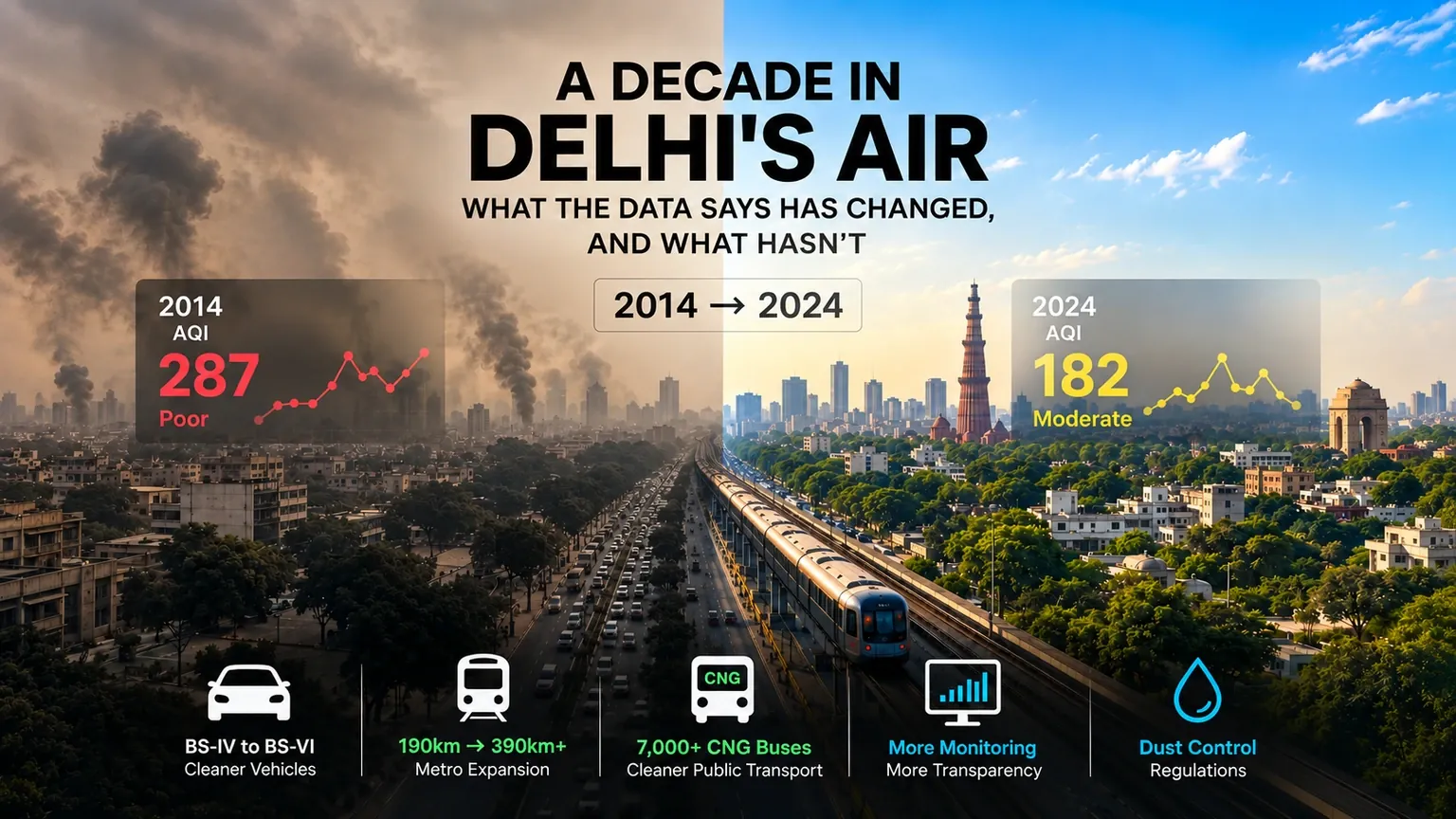
Delhi's air just did something unexpected. September was its cleanest in five years – even as the monsoon was leaving and the city moved closer to its notorious pollution season.
Delhi is used to a very different September story.
The monsoon begins to retreat. The humidity changes. The skies become less reliable. And somewhere in the background, the first warnings about winter pollution begin appearing.
This year, the numbers went the other way.
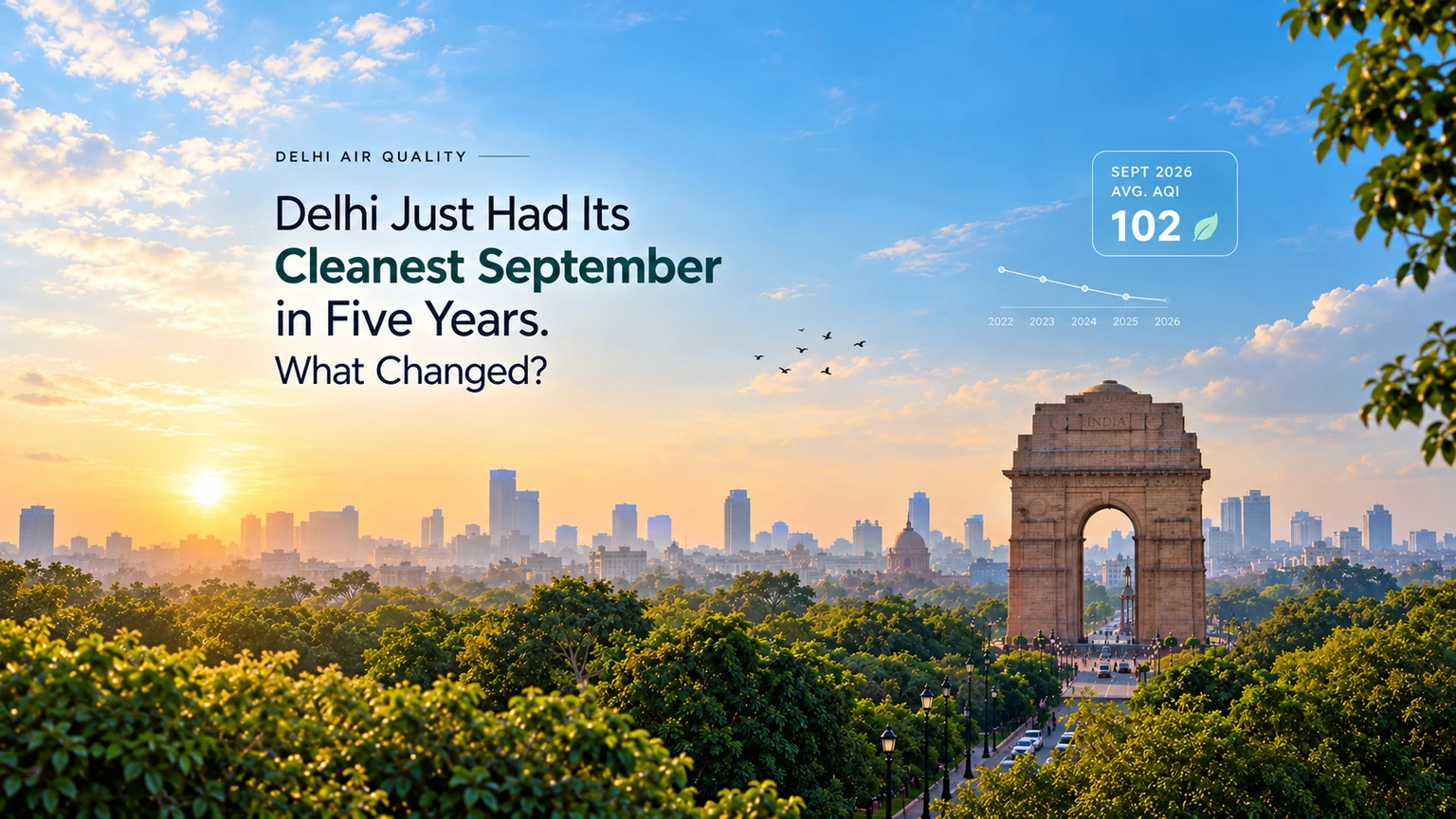
Delhi's average AQI for September 2026 was 102, the lowest September average in the 2022-2026 comparison. September averaged 104 in 2022, 108 in 2023, and 105 in both 2024 and 2025.
That's not a dramatic improvement.
But it is enough to make the next question interesting:
Why did Delhi's air improve just as the season that helped clean it was coming to an end?
The Five-Year September Pattern
The September numbers tell a remarkably consistent story.
| Year | September Average AQI |
|---|---|
| 2022 | 104 |
| 2023 | 108 |
| 2024 | 105 |
| 2025 | 105 |
| 2026 | 102 |
The difference between 102 and 105 is not enormous.
That's important.
This isn't evidence that Delhi has suddenly solved its air pollution problem. It is a small movement in the right direction, but one that becomes more interesting when placed alongside the rest of the year's data.
From January through September, Delhi recorded 194 days with an average AQI below 200, the highest number in the five-year comparison.
It also recorded 79 Poor-to-Severe days, the lowest number in the same period since 2022.
The broader trend, therefore, is better than September alone suggests.
But the really interesting part is what happened around the AQI number.
The Monsoon Left Early. The Clean Air Didn't Immediately Follow
Delhi's 2026 monsoon was unusual.
It arrived late, on July 2, and withdrew on September 23 – two days earlier than the normal withdrawal date and the shortest monsoon stay over Delhi since 2012.
Yet the city still received 728.6 mm of rainfall between June 1 and September 23, around 16% above its normal seasonal rainfall of 629.7 mm.
So this wasn't a simple case of:
More rain = cleaner air.
In fact, September's cleaner air came despite rainfall being lower than the previous year.
That's because rain is only one part of the equation.
Wind speed and direction matter.
Atmospheric mixing matters.
Temperature matters.
And the broader weather pattern across Delhi-NCR matters.
As CREA analyst Manoj Kumar explained, cleaner monsoon air is not simply a rainfall story; stronger atmospheric mixing and changing wind conditions can help disperse pollution even when rainfall itself isn't unusually high.
The atmosphere, in other words, did some of the heavy lifting.
The Strange Part: Some Pollution Actually Increased
There is another detail hiding behind the headline.
If Delhi's air was cleaner, you might expect every major pollutant to have fallen.
It didn't.
September's average PM2.5 was 39 µg/m³, compared with 35 µg/m³ in September 2025.
PM10 also increased slightly, from 104 to 106 µg/m³.
And yet the overall AQI was lower.
That isn't a contradiction.
AQI is a composite index rather than an average of every pollutant concentration. The pollutant driving the index can change from one period to another.
In September, NO₂ and ozone levels were lower than the previous year, while the overall AQI still came out at 102.
This is why a single headline number can sometimes hide a more complicated air-quality story.
Delhi didn't become uniformly cleaner.
Different parts of its pollution mix moved in different directions.
The Weather Was Doing More Work Than You Think
This is one of the least intuitive things about Delhi's pollution problem.
The amount of pollution being produced and the amount of pollution measured in the air are not the same thing.
A city can continue producing emissions while recording relatively better air because the atmosphere is dispersing those emissions efficiently.
Then the weather changes.
The wind weakens.
Atmospheric mixing decreases.
The air becomes more stable.
Suddenly, the same emissions are concentrated closer to where people live and breathe.
This is why Delhi's air quality can change dramatically without millions of cars suddenly appearing on the roads overnight.
The weather doesn't create the pollution.
It decides how much of it gets trapped.
And September 2026 appears to have been relatively forgiving.
Which Makes October More Interesting
September's number would be reassuring if the story ended there.
It doesn't.
The monsoon has withdrawn. The seasonal pattern is changing. And Delhi is moving toward the months when its atmospheric conditions become increasingly hostile to pollution dispersion.
October is the transition.
November is when the familiar Delhi pollution story can begin accelerating.
By then, emissions from transport, industry, construction and regional sources are interacting with a very different atmosphere.
Agricultural burning can add another layer during the October-November period.
None of these factors operates independently.
That's why Delhi's winter pollution cannot be explained by one culprit.
The same city can produce similar emissions on two different days and experience completely different AQI levels because the meteorology has changed.
So, Is Delhi Actually Getting Cleaner?
Maybe. But September alone can't prove it.
There are encouraging signals.
The January-September 2026 numbers are better than the previous four years on several measures.
Average PM2.5 through September 28 was 69 µg/m³, matching 2025 and below the corresponding figures for 2022, 2023 and 2024.
The number of heavily polluted days is down.
The number of days below AQI 200 is up.
And September produced the lowest average AQI of the five-year comparison.
Those are real improvements.
But weather can amplify or suppress pollution from year to year, making short-term comparisons difficult.
The harder question is whether the underlying emissions are falling fast enough to produce cleaner air even when the weather stops helping.
That is the test Delhi hasn't taken yet.
September Was the Good Part. Now Comes the Interesting Part.
There is something almost misleading about calling September 2026 a pollution success story.
It was a good month.
But it was also a month in which Delhi's atmosphere was still relatively capable of dispersing pollution.
The harder months are approaching.
If Delhi can carry some of this improvement into October, November and December, the story becomes much more significant.
If AQI climbs rapidly as soon as the seasonal conditions turn against the city, September may end up looking less like a structural improvement and more like a temporary reprieve.
Either way, the next few months will tell us more than September did.
Because the real question isn't:
“Was Delhi's air cleaner this September?”
We already know the answer.
It was.
The better question is:
“What happens when the weather stops helping?”
That is when we'll find out how much of Delhi's improvement belongs to the city and how much belonged to the atmosphere.
September gave Delhi a surprisingly good month.
Now October gets to test it.
September gave Delhi a surprisingly good month. Now October gets to test it. Track Delhi's live AQI as the season turns.
Check Delhi's AQI Now