Every winter, the headlines say the same thing: Delhi's air is at crisis levels, the worst in years, unprecedented pollution, no end in sight. Every summer, the crisis recedes from memory. Repeat.
But what does a decade of data actually show? Has anything changed? The answer is more nuanced than either the crisis headlines or the optimism of policy announcements suggest.
Tracking long-term air quality change requires stepping back from individual events. From the three consecutive bad days that generate a news cycle, and looking at the annual averages, the trend lines, the structural changes and their measured effects.
Here is an honest reading of Delhi's air quality data over the past decade.
What Has Genuinely Improved
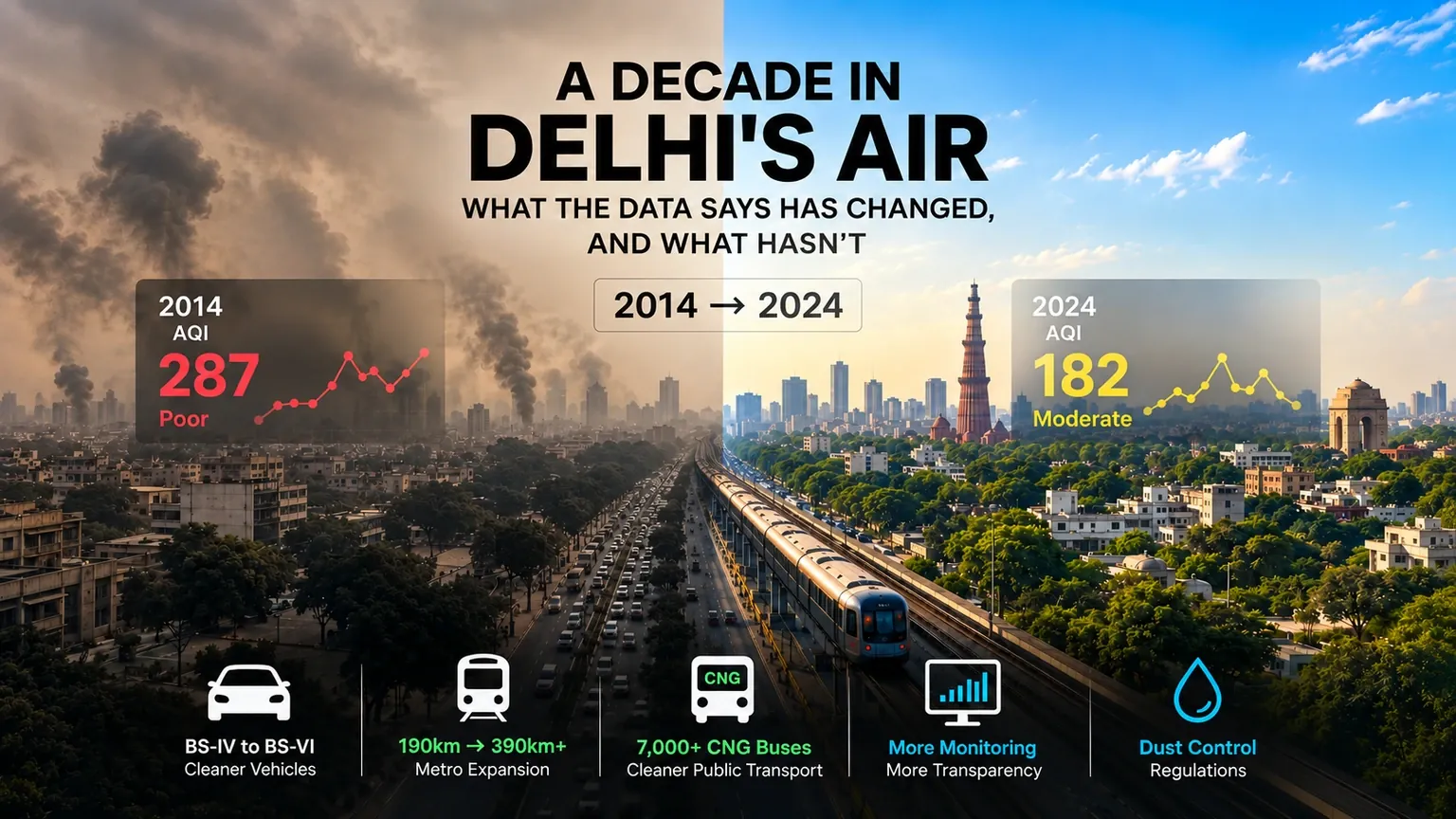
Vehicle emission standards: India's transition from BS-IV to BS-VI emission norms in April 2020 was a significant shift. BS-VI standards are broadly equivalent to Euro 6, representing a dramatic reduction in permissible particulate and NOₓ emissions per vehicle. Newer vehicles on Delhi roads emit substantially less per kilometer than the fleet did a decade ago.
Metro expansion: Delhi Metro's network grew from approximately 190 km in 2014 to over 390 km by the mid-2020s. Ridership, before and after the pandemic disruption, represents millions of vehicle trips diverted from road transport. This is a measurable emissions reduction from a system that didn't exist at this scale a decade prior.
CNG bus fleet: Delhi's public bus fleet is almost entirely CNG-powered, replacing older diesel vehicles. The city had nearly 7,000 CNG buses operating through DTC by the early 2020s. This substitution makes a measurable difference in the NOₓ and PM contribution from the bus sector.
Real-time monitoring infrastructure: Delhi had a handful of air quality monitoring stations in 2014. Today, the network is significantly denser – more stations, more pollutants tracked, more publicly accessible data. This doesn't directly improve air quality, but it changes the information environment. Policy makers, courts, and citizens have more data to act on.
Dust control regulations: Construction site water spraying requirements, road washing programs in high-traffic corridors, and penalties for dust-generating activities have all been operationalized to varying degrees. Enforcement is uneven, but the regulatory framework exists in a way it didn't a decade ago.
What Hasn't Changed
Annual average PM2.5: Despite the improvements above, Delhi's annual average PM2.5 concentration, the most health-relevant long-term metric has not shown a consistent downward trend. Some years are lower than others, largely driven by monsoon timing and winter weather patterns. But the structural baseline, accounting for meteorological variation, is not dramatically different from a decade ago.
This is the uncomfortable truth at the heart of Delhi's air quality story: the reforms implemented so far have not been sufficient to reduce the annual pollutant load against the backdrop of a growing population, expanding city footprint, and continued dependency on road transport.
Agricultural burning: The stubble burning coordination problem remains largely unsolved. Incentives for farmers to adopt alternatives to burning have been scaled up, zero-tillage equipment subsidies, Happy Seeder programs, but adoption rates remain insufficient relative to the scale of the practice.
Industrial growth in NCR periphery: The NCR's industrial hinterland – Faridabad, Ballabhgarh, Ghaziabad, Greater Noida – has grown substantially. Some of this growth has moved polluting activity into areas with weaker monitoring and enforcement.
The Trajectory Question
Is Delhi's air getting better or worse? The most defensible answer is: approximately flat over the past decade, with significant year-to-year variation driven by weather, and with the balance of evidence suggesting that the positive policy changes are being roughly offset by growth.
This is not the same as saying reform doesn't matter. Without the BS-VI transition, the Metro expansion, and the CNG fleet, Delhi's air would be measurably worse. The reforms are holding the line while the city grows.
The question is whether the next decade can produce enough structural change – faster electrification of transport, genuine resolution of the agricultural burning issue, meaningful industrial relocation and clean energy transition, to shift the curve downward rather than just maintain it.
The Long View
Delhi's air quality problem is generational. It was built over decades of rapid urbanization without corresponding environmental infrastructure. It won't be solved in a five-year plan.
But the 10-year data also shows that meaningful changes that affect the daily pollution load by measurable percentages are achievable within normal policy time horizons. The BS-VI transition happened. The Metro got built. The monitoring network expanded. These are not small things.
The question is what the next set of changes will be, and whether the political will exists to implement them fast enough to matter.
The dashboard shows where we are today. The trend charts show where we've been. The space between is where decisions get made.
See Delhi's air right now — and track the trend over time. The 30-day AQI chart on the dashboard is the most honest read of where things stand.
View Delhi's AQI Trend