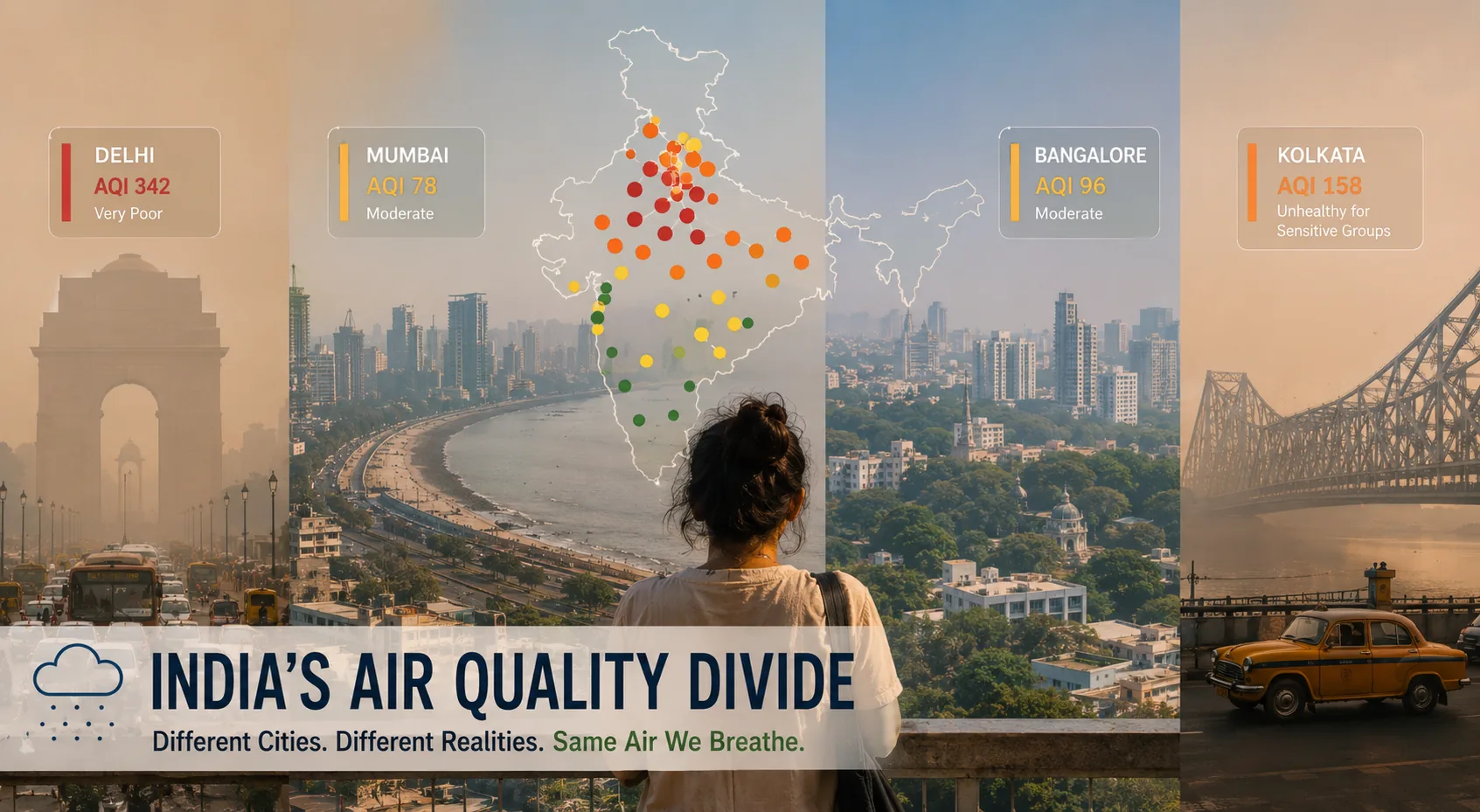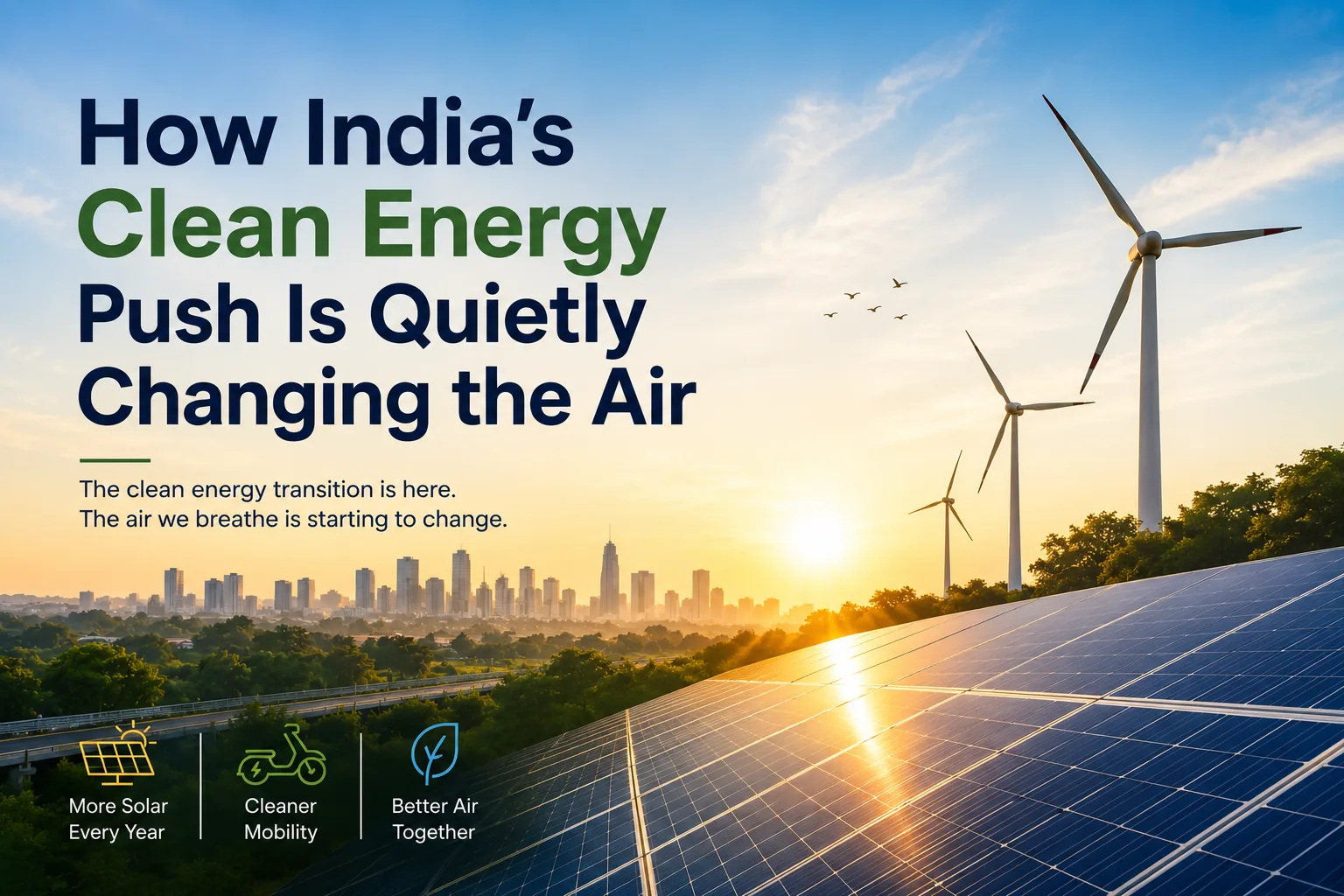
India added more solar capacity in the last five years than most European countries have in total. This is not a minor footnote in the global clean energy story. And its relationship to air quality, while complicated, is one of the most important long-term trends in the country's environmental trajectory.
India's energy story is one of contradictions held simultaneously. The country is the world's third-largest consumer of coal, with hundreds of coal-fired power plants contributing significantly to national PM2.5 and SO₂ levels. At the same time, India is among the top five solar power producers globally, has set ambitious renewable targets, and is deploying electric vehicles and clean cooking technologies at a scale that few national-level programs match.
Both things are true at once. And understanding the direction as well as the trend matters more than the snapshot.
The Coal Reality
India's electricity grid is still heavily coal-dependent. Thermal power plants are a major source of SO₂ and nitrogen oxide emissions, both of which are direct precursors to secondary particulate matter. These are the fine particles that form in the atmosphere from chemical reactions and end up in your lungs.
The concentration of coal plants in regions like Vidarbha (Maharashtra), parts of Jharkhand, and around Singrauli in Madhya Pradesh creates local air quality conditions that rarely enter national conversation but are acutely felt by residents.
Emission norms for thermal power plants were strengthened in 2015, requiring flue gas desulphurisation and other upgrades by 2017. Compliance has been slow and uneven but the regulatory intent represents a structural shift from a decade prior when coal plants operated with minimal emission controls.
Solar and Wind: What's Actually Happening
India's solar deployment has been among the fastest in the world over the past decade. Rajasthan, Gujarat, Karnataka, and Tamil Nadu now host massive utility-scale solar installations. Wind capacity has grown substantially in coastal and peninsular regions.
Every megawatt of solar generation that displaces coal generation eliminates the emissions that would have accompanied that coal. At the grid scale, the cumulative effect, while not yet transformative, is measurable.
Several studies have attempted to model the air quality benefits of India's renewable energy transition. The directional finding is consistent: as the share of renewables grows, the atmospheric load of SO₂ and NOₓ from the power sector declines. The pace of that improvement depends on how fast coal capacity is retired; not just how fast renewables are added.
Electric Vehicles: The Urban Air Quality Angle
India's EV market is growing rapidly, particularly in the two-wheeler and three-wheeler segments. Two-wheelers are among the largest contributors to urban vehicular pollution due to their volume. There are more two-wheelers on Indian roads than any other vehicle category by a significant margin.
The transition to electric two-wheelers and autorickshaws represents one of the highest-leverage interventions for urban air quality available. Cities like Pune, Hyderabad, and Delhi are seeing rising EV penetration, and the effect, while early, is part of a trajectory that air quality advocates track closely.
Ujjwala and Clean Cooking
One of the most significant contributors to indoor and ambient air pollution in rural India is biomass combustion for cooking. The PMUY (Pradhan Mantri Ujjwala Yojana) scheme, which has distributed LPG connections to tens of millions of below-poverty-line households, represents one of the largest clean cooking interventions in history.
The air quality impact of replacing biomass cookstoves with LPG is well-documented at the household level, particularly for women and children who spend the most time near the cooking area. At scale, the cumulative effect on ambient rural air quality is positive, though the full benefit depends on actual usage rates, which have been variable.
The Honest Assessment
India's clean energy transition is real, meaningful, and materially behind where it needs to be to solve the country's air quality crisis within a generation. The right framing is: significant progress being made, significantly faster progress needed.
The data on the dashboard captures today. The trend, if you look at the multi-year lines, contains reasons for cautious optimism. The challenge is ensuring that the structural investments in clean energy and transport happen faster than the growth in pollutant-generating activity.
That tension is where India's air quality future will be decided.
See what India's air looks like city by city, right now. The live map updates every hour — compare your city to others across the country.
Open India AQI Map