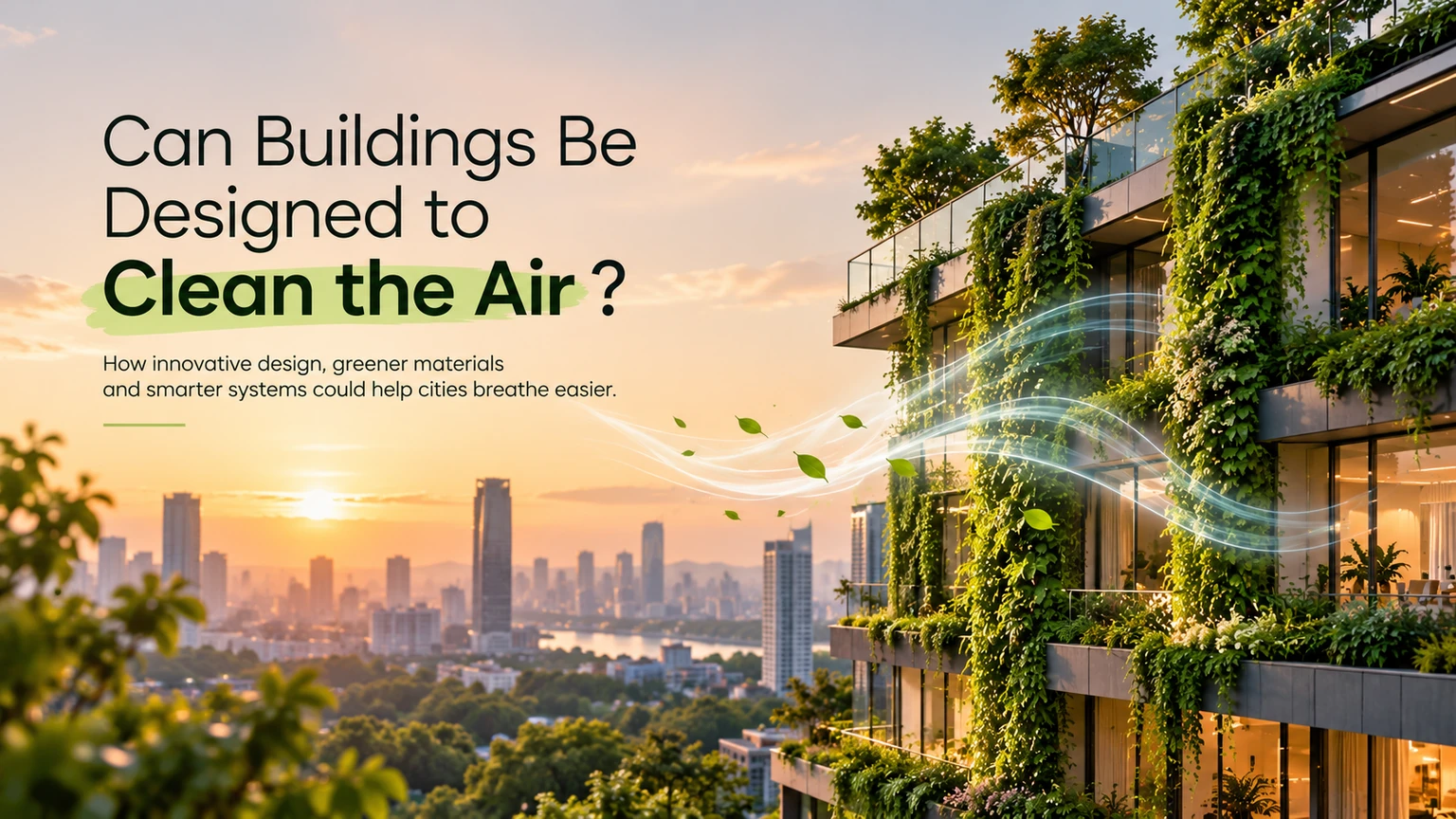
What if the buildings surrounding us didn't just occupy space in a city, but actively helped make its air cleaner?
Cities are getting taller. Buildings are getting smarter. Architecture is becoming more ambitious, with vertical gardens, energy-generating façades and structures designed to interact with their surroundings.
But there is another possibility emerging from this evolution.
What if buildings could do more than simply provide shelter? What if their walls, roofs and ventilation systems could help remove pollutants from the air?
It sounds futuristic, but researchers and architects are already exploring ways to make this happen.
From special coatings that react with sunlight to walls covered in vegetation and advanced filtration systems, the idea of pollution-responsive architecture is moving beyond the drawing board.
The question is whether buildings can become part of the solution to one of the biggest challenges facing modern cities.
What if the walls around us could do more than stand there?
Traditional buildings are designed around familiar priorities: structural strength, energy efficiency, comfort, appearance and cost.
Air quality is increasingly becoming another consideration.
One approach involves using building materials that interact with pollutants rather than simply allowing them to accumulate on their surfaces.
These materials are known as photocatalytic materials.
Some contain titanium dioxide (TiO₂), a compound that reacts with ultraviolet light. When exposed to suitable light, it can trigger chemical reactions that transform certain pollutants, including nitrogen oxides, into other compounds.
The idea is relatively simple.
Instead of treating every building surface as passive, why not use the enormous surface area of a city as an opportunity to tackle some of its pollution?
Photocatalytic coatings have been tested in paints, concrete, tiles and other construction materials.
In theory, an entire building could become a reactive surface.
In practice, however, the results depend on sunlight, humidity, pollutant concentration, surface condition and the amount of air actually coming into contact with the material.
A coating that works well in a controlled laboratory experiment may perform very differently on a busy city street.
Still, it opens an interesting possibility: architecture that actively interacts with the atmosphere.
The rise of buildings that grow green
There is another approach that is already visible in cities around the world.
Look at buildings with vegetation covering their walls. What might appear to be an aesthetic design choice can also have environmental functions.
These structures are commonly called green walls or vertical gardens.
Unlike conventional landscaping, they bring vegetation directly onto building surfaces, making use of vertical space where ground-level planting may be limited.
Plants can interact with airborne particles through deposition on their leaves and surfaces. Vegetation can also absorb certain gaseous pollutants through its leaves.
The surrounding soil and growing medium may contribute to other environmental functions.
But the benefits depend heavily on plant selection, density, maintenance, local weather and building design.
A green wall isn't automatically an air purifier for an entire neighbourhood.
In some urban street configurations, dense vegetation can even restrict airflow and reduce the dispersion of pollution.
That is why the location and design of greenery matter just as much as its presence.
The opportunity is particularly interesting in densely built cities where there is limited space for conventional parks.
A building's façade could become an additional surface for urban greenery without requiring more land at street level.
Can a building breathe cleaner air into its surroundings?
Perhaps the most practical opportunity lies inside buildings.
Think about how much time people spend indoors.
Homes, offices, schools, shopping centres, hospitals and public buildings are all spaces where people spend significant portions of their day.
The US Environmental Protection Agency notes that people spend approximately 90% of their time indoors on average, although this varies between individuals and locations.
Indoor air quality therefore matters enormously.
Buildings can be designed to manage the air entering and circulating through them using mechanical ventilation, filtration and air-cleaning systems.
For example, advanced HVAC systems can filter incoming air before distributing it throughout occupied spaces.
High-efficiency filters can capture many airborne particles, including fine particulate matter, when appropriately selected, installed and maintained.
Other technologies can address particular gaseous pollutants, depending on the filtration media and system design.
This creates an important distinction.
A building may not clean the air across an entire city, but it can provide a substantially cleaner indoor environment for the people using it.
And that is already a meaningful application of air-quality-focused architecture.
When the building itself becomes an air filter
Imagine an office building that continuously monitors the air outside.
When outdoor pollution levels rise, its ventilation system adjusts how much outside air enters, where that air is drawn from and how effectively it is filtered.
Inside, sensors track particulate matter, carbon dioxide, temperature and humidity.
The system responds to changing conditions rather than operating at a fixed setting throughout the day.
This is the basic idea behind intelligent building ventilation.
Modern building-management systems can integrate air-quality sensors, automated controls and filtration equipment to improve indoor environmental conditions.
Some systems can also adjust ventilation based on occupancy, helping balance indoor air quality and energy consumption.
However, there is an important engineering challenge.
More ventilation isn't always better if the outdoor air is heavily polluted.
Bringing untreated outdoor air inside during a pollution episode can increase indoor exposure.
A well-designed system needs to balance fresh-air requirements, filtration, indoor pollutant sources, energy use and outdoor conditions.
The goal isn't simply to move more air.
It's to manage the quality of the air being moved.
The architecture experiments already happening
This isn't just a theoretical conversation. Researchers have been testing different ways of integrating pollution-reducing technologies into the built environment.
1. Photocatalytic concrete and paint
Certain construction materials use titanium dioxide to initiate chemical reactions that can break down nitrogen oxides under suitable lighting conditions.
These materials have been tested on roads, pavements, façades and other urban surfaces.
Their real-world effectiveness remains an important research question. Field performance can be significantly lower than laboratory results, and researchers must also consider the formation of reaction by-products and the long-term durability of the coatings.
2. Vertical forests and green façades
Buildings that incorporate extensive vegetation offer a different approach.
Their potential benefits include particle deposition, some gaseous pollutant uptake, reduced surface temperatures and improved urban greenery.
Projects such as Milan's Bosco Verticale demonstrate how vegetation can become an integral part of high-rise architecture rather than an addition to the surrounding landscape.
The buildings are not proven city-scale air-purification machines, but they illustrate how architecture can incorporate ecological functions.
3. Advanced filtration and ventilation
Commercial buildings, hospitals and educational institutions can integrate filtration directly into their air-handling systems.
Instead of relying entirely on portable air purifiers, these buildings can treat larger volumes of air through centrally managed systems.
This is one of the more established approaches because it targets a defined indoor environment and can be evaluated using measurable engineering performance.
4. Buildings that monitor their own environment
Smart sensors can track indoor and outdoor air-quality conditions.
When connected to building-management systems, these measurements can help operators identify ventilation problems, detect changing pollution conditions and optimise filtration.
The more advanced vision is a building that continuously responds to its surrounding environment.
It doesn't just monitor the air.
It uses the information to make decisions about how the building operates.
But can buildings actually clean the air outside?
Here is where expectations need to be realistic.
A building can filter the air circulating inside it. It can incorporate materials that interact with selected pollutants. It can support vegetation and influence how air moves around its structure.
But cleaning the atmosphere outside is a much harder problem.
Cities contain enormous volumes of constantly moving air. Wind, temperature, atmospheric chemistry and emissions from thousands of sources all influence pollution concentrations.
A surface that removes some pollutants in its immediate vicinity may have a negligible effect on the air quality of an entire city.
Research into photocatalytic materials has highlighted this gap between promising laboratory results and real-world performance.
Similarly, the effectiveness of green walls varies with their design and surroundings.
A building covered in plants may provide useful local environmental benefits without producing a measurable improvement in citywide AQI.
This distinction matters because architecture should be evaluated on what it actually achieves, not simply how environmentally advanced it looks.
The most credible opportunities may come from combining several approaches rather than expecting one technology to solve everything.
What would a pollution-responsive city look like?
Now imagine taking these ideas beyond individual buildings.
Instead of treating each structure as an isolated object, cities could begin designing entire districts around how air moves and how buildings interact with their surroundings.
Buildings could incorporate green façades where appropriate, roofs could support vegetation, and construction materials could be selected for their environmental performance.
Street layouts could preserve ventilation corridors.
New developments could consider how building height, spacing and orientation influence wind movement and the accumulation of pollutants.
Indoor environments could be equipped with smart ventilation and filtration systems that respond to outdoor air conditions.
The result would not be a city where every building acts as a giant air purifier.
It would be a city where architecture, infrastructure and environmental engineering work together to reduce exposure and make pollution easier to manage.
This approach could be particularly valuable in dense urban areas where limited space makes conventional environmental interventions difficult.
It also changes the way we think about sustainable architecture.
A building would no longer be judged only by how much energy it consumes or how efficiently it uses space.
Its relationship with the surrounding environment could become part of the design conversation.
The challenge: Cleaner buildings cannot replace cleaner cities
There is a risk in becoming too enthusiastic about technological solutions.
If a city continues producing large quantities of pollution from vehicles, industrial activity, power generation and other sources, building-level technologies cannot compensate for all of it.
A green façade cannot replace emissions controls.
An advanced ventilation system cannot make a heavily polluted city clean.
Photocatalytic concrete cannot eliminate the need for cleaner transport and energy.
The most effective approach is to reduce pollution at its source while using buildings to limit exposure and support healthier urban environments.
Architecture can be part of that strategy, but it cannot carry the entire responsibility.
And perhaps that is the most interesting aspect of this emerging field.
The future of cleaner cities may not depend on one extraordinary invention. It may depend on thousands of smaller design decisions made across buildings, streets and infrastructure.
The future of architecture might be about the air we breathe
For decades, buildings have largely been designed around the needs of the people inside them.
Now, as cities face growing environmental pressures, the relationship between buildings and their surroundings is becoming more important.
The walls, roofs, windows and ventilation systems that make up our built environment could play a larger role in managing pollution.
Some technologies are already practical. Others are still being tested. And some ambitious ideas may need significant improvements before they can deliver meaningful results at scale.
But the direction is worth watching.
Perhaps the next generation of iconic buildings won't just be recognised for their height, shape or appearance.
They might also be recognised for how intelligently they interact with the environment around them.
Because the buildings of tomorrow shouldn't just be designed for the world we live in. They should help make that world better to breathe in.
Buildings can limit exposure, but cleaner air starts with knowing what's outside. Check live AQI before you decide when to ventilate.
Explore the Live AQI Map