There is a tempting way to think about air pollution: a city is polluted because it has too many cars, too many factories or too many people. Reality is much more interesting - cleaner cities almost never rely on a single fix.
There is a tempting way to think about air pollution. A city is polluted because it has too many cars, too many factories or too many people. Therefore, cleaner air simply requires fewer cars, fewer factories or fewer people.
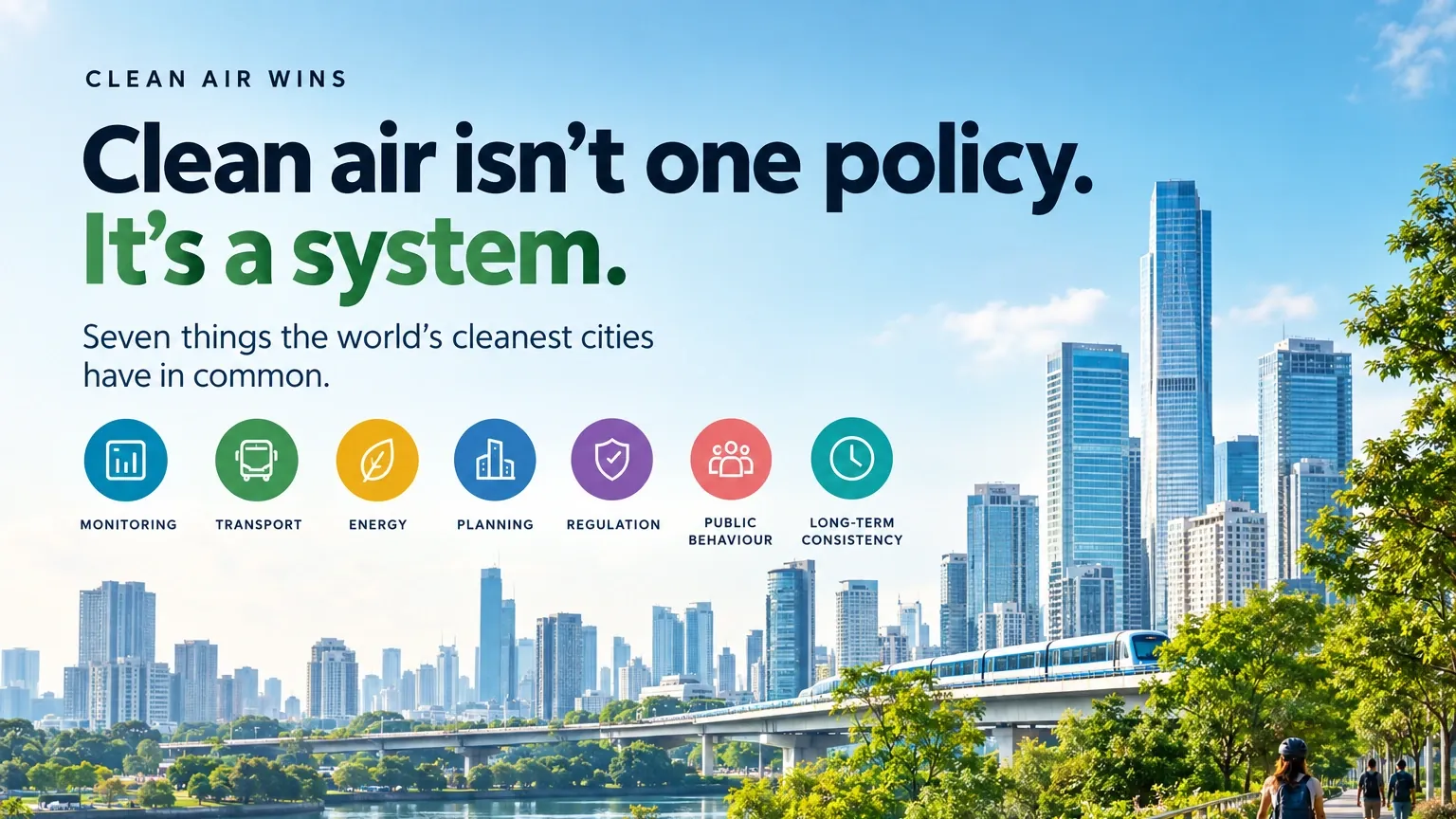
Reality is much more interesting. Cities with better air quality tend to combine multiple interventions: cleaner transport, better urban planning, cleaner energy, monitoring, enforcement and public behaviour. There is no single "clean-air switch."
That matters because cities around the world are trying to solve fundamentally similar problems under very different conditions. What follows is not a ranking. It is the set of things that keep showing up wherever the air has genuinely improved.
They Measure What Is Happening
You cannot manage what you cannot see. Modern air-quality monitoring has changed environmental decision-making by making pollution more visible.
Monitoring networks allow authorities and researchers to identify:
- Pollution hotspots. The specific corridors, junctions and industrial clusters where concentrations run persistently above the citywide average.
- Seasonal patterns. The months when meteorology traps emissions close to the ground rather than dispersing them.
- Traffic-related pollution. How readings track the working day, and where roadside exposure diverges from the ambient background.
- Industrial sources. Emissions that are localised, intermittent, and often invisible in a citywide average.
- Long-term trends. Whether the baseline is actually moving once weather variation is accounted for.
- Sudden pollution events. The fires, inversions and incidents that need a response within hours rather than years.
The WHO's global air-quality guidelines cover PM2.5, PM10, ozone, nitrogen dioxide, sulfur dioxide and carbon monoxide because different pollutants require different approaches. A city that tracks only one number is effectively managing one problem out of six.
Data does not clean the air. But it tells you where to intervene.
Transport Is Treated as Infrastructure, Not Just Convenience
Cleaner cities generally give residents alternatives to private vehicles. That can mean metro systems, reliable buses, walking infrastructure, cycling networks, electrification, integrated ticketing and transit-oriented development.
The important idea is not simply to make people stop driving. It is to make the cleaner choice practical.
If public transport is slow, unreliable or uncomfortable, people with the option will often return to cars. The quality of a bus network is not a transport-department detail sitting downstream of air quality. It is one of the levers that sets it. Urban transport therefore becomes an air-quality issue.
Urban Design Affects How Pollution Moves
A city is not just buildings placed next to roads. Street width, building height, vegetation, traffic density and airflow can all influence how pollutants disperse.
Dense urban corridors can behave differently from open areas. Poorly designed streets can concentrate emissions exactly where pedestrians spend the most time, which means two locations a few hundred metres apart can offer very different air to the people standing in them.
Integrated planning is increasingly treated as a way to connect transportation, housing, environmental health and biodiversity rather than treating them as separate problems. That is a major shift in thinking.
Energy Policy Becomes Air-Quality Policy
Electricity generation is often discussed as a climate issue. But it is also an air-quality issue.
Combustion can release particulate matter and gases that either directly affect health or contribute to secondary pollution formed downwind of the source. That means the transition toward cleaner energy can deliver benefits well beyond carbon emissions.
The relationship is not instant. Renewable capacity does not automatically mean every fossil-fuel source disappears, and new capacity can sit alongside existing generation rather than replacing it. But the direction matters.
They Use Policy Continuously, Not Only During Crises
A common mistake is treating air pollution like a fire. Wait until the air becomes terrible. Declare an emergency. Restrict something. Wait for the AQI to fall. Repeat.
A more effective approach is continuous management: monitor, identify sources, intervene, measure, adjust, and then keep going once the readings improve rather than standing down.
That sounds less dramatic. It is also more sustainable, because emergency measures are designed to shave a peak, not to move the annual average that determines long-term health outcomes.
They Make Information Accessible
Air quality becomes more actionable when ordinary people can understand it. A resident should not need a degree in atmospheric science to know:
- Whether today is a good day for outdoor exercise.
- Whether pollution is rising or easing over the next few hours.
- Which pollutant is driving the AQI, since the headline number is set by whichever one is worst.
- How today's conditions compare with yesterday.
- Whether the city is improving over time, or simply having a good week.
This is where public dashboards become important. Good environmental technology translates complexity into useful decisions without hiding the complexity underneath.
They Think in Decades
The hardest part of air-quality improvement is that pollution sources are tied to how cities grow: housing, roads, industry, energy, public transport, waste, construction, population and economic development.
A city cannot redesign all of those overnight. The encouraging part is that meaningful improvement is possible when interventions continue long enough to change the underlying system rather than the readings in one bad month.
UNEP describes cities as hotspots for pollution and argues that systemic changes in infrastructure and planning are needed to deliver health and environmental benefits.
The Real Lesson
Cleaner air is not about creating a perfect city. It is about creating a city where thousands of small decisions consistently move in the same direction.
A bus replacing hundreds of car journeys. A building using efficient ventilation. A road designed for walking. A power plant reducing emissions. A city monitoring its pollution. A resident choosing the cleaner hour for a run. A policymaker looking at ten years of data rather than one bad week.
Air quality improves when the system improves. And systems can change.
See how cities around the world compare today. Explore current AQI levels, trends and city-to-city differences side by side.
Compare Global Cities