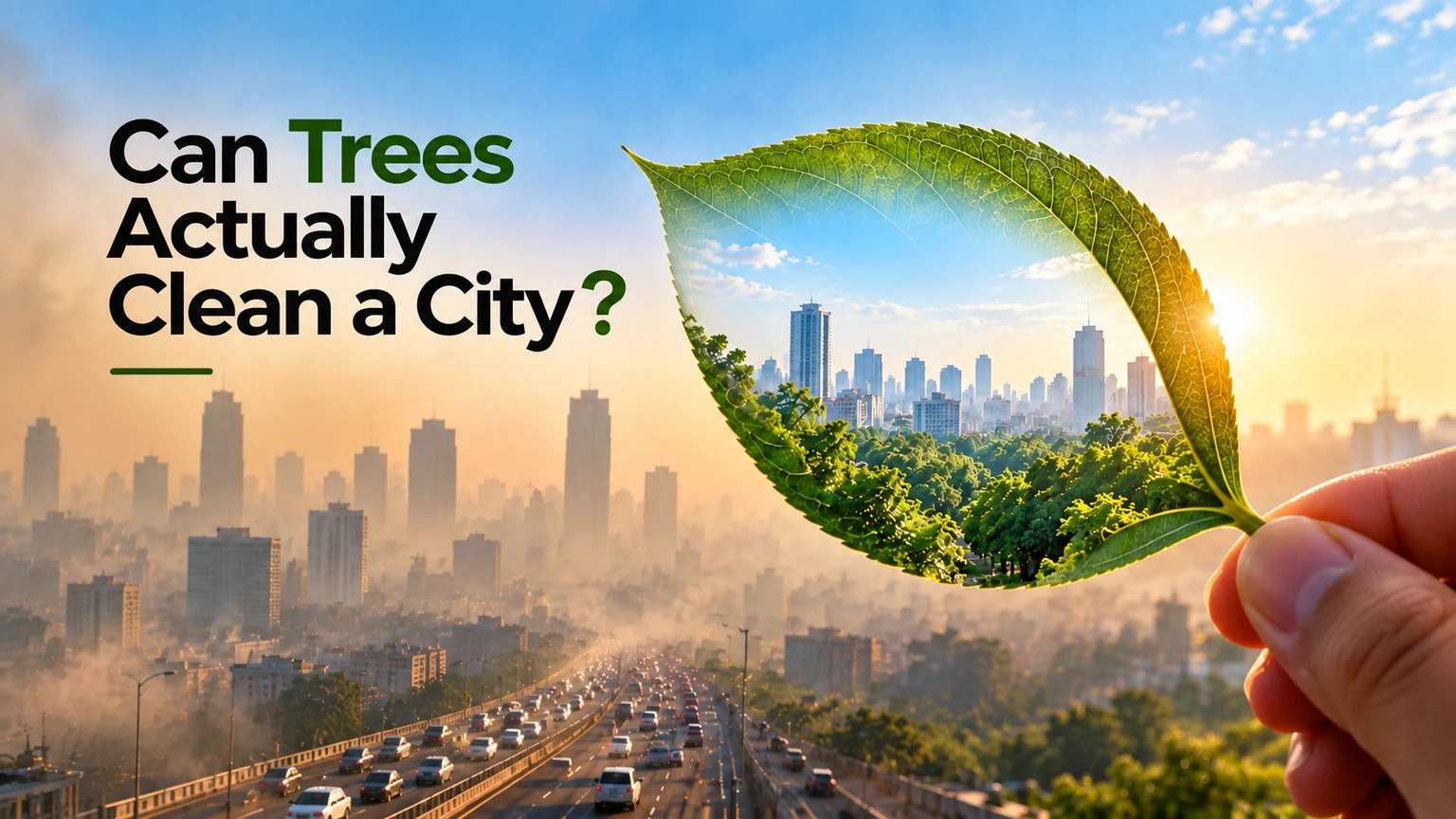
When a city struggles with air pollution, one solution appears almost immediately: plant more trees. Trees can help improve urban air quality – but they cannot compensate for unlimited pollution emissions.
We keep being told to plant more trees.
When a city struggles with air pollution, one solution appears almost immediately:
Plant more trees.
It makes intuitive sense.
Trees absorb carbon dioxide.
They release oxygen.
Their leaves can capture particles.
Parks make cities cooler and more pleasant.
So why not simply plant enough trees to clean the air?
Because cities are more complicated than that.
Trees can help improve urban air quality – but they cannot compensate for unlimited pollution emissions.
And understanding that difference changes how we should think about urban greenery.
What do trees actually do for air quality?
Trees interact with the atmosphere in several ways.
Their leaves, branches and bark can capture some airborne particles. Vegetation can also influence local temperature, humidity and airflow.
Trees provide shade, reduce heat exposure and contribute to healthier urban environments in ways that extend far beyond pollution.
But the amount of pollution removed depends on several factors:
- Tree species
- Leaf characteristics
- Tree size and maturity
- Local climate
- Season
- Pollution concentration
- Wind
- Street layout
- Density of vegetation
So saying "trees remove pollution" is true.
Saying "trees will clean a polluted city" is a much bigger claim.
A tree is not a giant air purifier
This is probably the most important distinction.
A city produces pollution continuously.
Cars and trucks emit pollutants.
Industries release emissions.
Construction creates dust.
Roads accumulate and redistribute particles.
Waste can be burned.
Power generation can produce emissions.
Trees cannot simply absorb all of this.
Think of it this way:
Trees can help manage the environment around pollution sources.
They cannot make the sources disappear.
If a city has a major traffic problem, planting trees beside every road does not eliminate vehicle emissions.
If an industrial facility is releasing excessive pollutants, a forest nearby isn't a substitute for emission controls.
If construction dust is spreading across a neighbourhood, planting trees doesn't remove the need for dust management.
The cleanest pollution is the pollution that was never emitted.
Trees are part of the solution, not the entire solution.
But here's where it gets interesting: location matters
Imagine two cities that plant exactly 100,000 trees.
City A plants most of them in large peripheral areas.
City B strategically adds vegetation around neighbourhood parks, pedestrian areas, heat hotspots and selected urban corridors.
They have planted the same number of trees.
But their urban benefits won't necessarily be the same.
This is because where greenery exists matters.
Urban planners need to think about:
- Where is pollution highest?
- Where do people spend time outdoors?
- Where are schools located?
- Where are major pedestrian routes?
- Where are heat hotspots?
- Where is green space lacking?
- How does air move through the street?
Once you ask these questions, tree planting stops being simply a numbers game.
It becomes an urban-design problem.
More greenery isn't automatically better everywhere
Here's a counterintuitive part.
You might imagine that the best approach is to create a dense wall of vegetation alongside every busy road.
But urban airflow matters.
In some narrow, enclosed street environments, dense vegetation combined with surrounding buildings can restrict air movement and affect how pollutants disperse.
That doesn't mean:
"Trees make pollution worse."
It means the design of green infrastructure matters.
A wide urban park is different from a narrow street canyon.
A line of trees beside an open road is different from dense vegetation between tall buildings.
A roadside green barrier is different from a forest.
The same tree can have different effects depending on its environment.
So where can urban greenery make a difference?
The value of trees extends well beyond directly removing particles.
1. Cooling cities
Concrete and asphalt absorb and retain heat.
Trees provide shade and can contribute to cooler local environments.
That matters as Indian cities experience increasing heat stress.
A shaded footpath isn't just more attractive.
It can make walking more comfortable.
2. Creating more walkable neighbourhoods
A pleasant, shaded street can encourage people to walk.
That creates an indirect environmental benefit.
If a short trip that might otherwise have been made by car becomes a walking trip, emissions can potentially be avoided at the source.
The tree didn't remove the vehicle's pollution.
It helped create an environment where the vehicle wasn't needed.
That's a very different, and more interesting way to think about urban greenery.
3. Supporting biodiversity
Cities aren't separate from nature.
Urban parks, tree corridors and connected green spaces can provide habitat for birds, insects and other species.
A city designed with ecological systems in mind can become more resilient.
4. Improving the experience of public spaces
There is also a human dimension.
People want neighbourhoods where they can sit outside.
Children need places to play.
Older adults need comfortable walking environments.
Communities benefit from accessible public spaces.
Clean air is not only about reducing a number on a dashboard.
It is about creating cities where people can comfortably live their lives.
India doesn't need one "tree solution"
This becomes particularly important when talking about India.
Ahmedabad isn't Bengaluru.
Bengaluru isn't Chennai.
Chennai isn't Kolkata.
Kolkata isn't Lucknow.
Each city has different:
- Climate
- Rainfall
- Wind patterns
- Urban density
- Traffic
- Industrial activity
- Building patterns
- Green-cover distribution
- Pollution sources
That means urban greenery needs to be locally designed.
A strategy that works well in a coastal city may not translate directly to a dense inland city.
A tree species that thrives in one climate may not be appropriate everywhere.
A green corridor that improves one street could create different airflow conditions on another.
This is why environmental planning increasingly depends on combining multiple datasets.
Imagine putting greenery on an AQI map
This is where things get exciting.
Imagine opening a city map.
You see:
- AQI
- PM2.5
- Traffic
- Wind direction
- Temperature
- Green spaces
- Population density
- Pollution hotspots
Now you aren't simply looking at a pollution map.
You're looking at a city system.
You could begin asking:
Where are the highest pollution hotspots?
Where are the biggest gaps in green space?
Which neighbourhoods have both high pollution and high population density?
Where are schools located relative to major roads?
Which areas have the greatest access to parks?
Does pollution change around major green corridors?
Those questions are much more useful than simply counting trees.
Can trees lower AQI?
This is where we need to be careful.
AQI is calculated from pollutant concentrations.
Trees can influence pollutant concentrations under certain conditions, particularly by interacting with particulate matter and some gaseous pollutants.
But the effect varies enormously by location and pollutant.
So, we shouldn't promise:
"Plant more trees → AQI falls by X points."
That would oversimplify a complex system.
Instead, think about trees as one layer of urban environmental infrastructure.
The other layers include:
- Cleaner transport
- Industrial emission controls
- Dust management
- Waste management
- Cleaner energy
- Better public transport
- Urban planning
- Monitoring
- Green infrastructure
Together, these can move a city toward cleaner air.
What if we stopped asking "How many trees?"
This might be the better question:
"Where does a city need nature most?"
A neighbourhood with almost no shade may need trees for thermal comfort.
A pedestrian corridor beside a busy road may need carefully designed vegetation.
A dense urban area may need accessible parks.
A heat hotspot may benefit from tree canopy.
A polluted industrial zone may require emission controls first.
A school beside a major road may need a completely different intervention.
The answer isn't always another tree.
Sometimes it's a bus.
Sometimes it's a cycling lane.
Sometimes it's better ventilation.
Sometimes it's dust control.
Sometimes it's an emissions standard.
Sometimes it really is a forest.
Good environmental planning knows the difference.
The best cities don't choose between technology and nature
There is a tendency to put environmental solutions into separate boxes.
Technology on one side.
Nature on the other.
But the future of urban air quality will probably need both.
Sensors can tell us where pollution is concentrated.
Satellites can help reveal regional patterns.
AQI platforms can make the information understandable.
Urban planning can identify intervention points.
Green infrastructure can improve local environments.
Cleaner transport can reduce emissions.
And better monitoring can tell us whether any of it is actually working.
The goal isn't to make cities look greener on a map.
It's to make them function better for the people living in them.
So, can trees actually clean a city?
Yes – but not by themselves.
Trees can capture some pollutants, provide shade, support biodiversity and improve urban environments.
But they cannot replace the systems that create pollution in the first place.
The strongest approach is not:
Trees vs. technology.
Or:
Nature vs. infrastructure.
It is:
Data + planning + cleaner systems + green infrastructure.
And perhaps that's the most important lesson.
A cleaner city isn't created by one spectacular intervention.
It is built from hundreds of decisions that work together.
Before you plant the next tree, look at the map.
Where is pollution highest?
Where do people walk?
Where is the city hottest?
Where is green space missing?
Where does traffic concentrate?
Where does the wind move?
The answers can tell us much more than a tree-counting headline ever could.
Before you plant the next tree, look at the map. See live AQI and area air scores for your city.
Explore the Live AQI Map