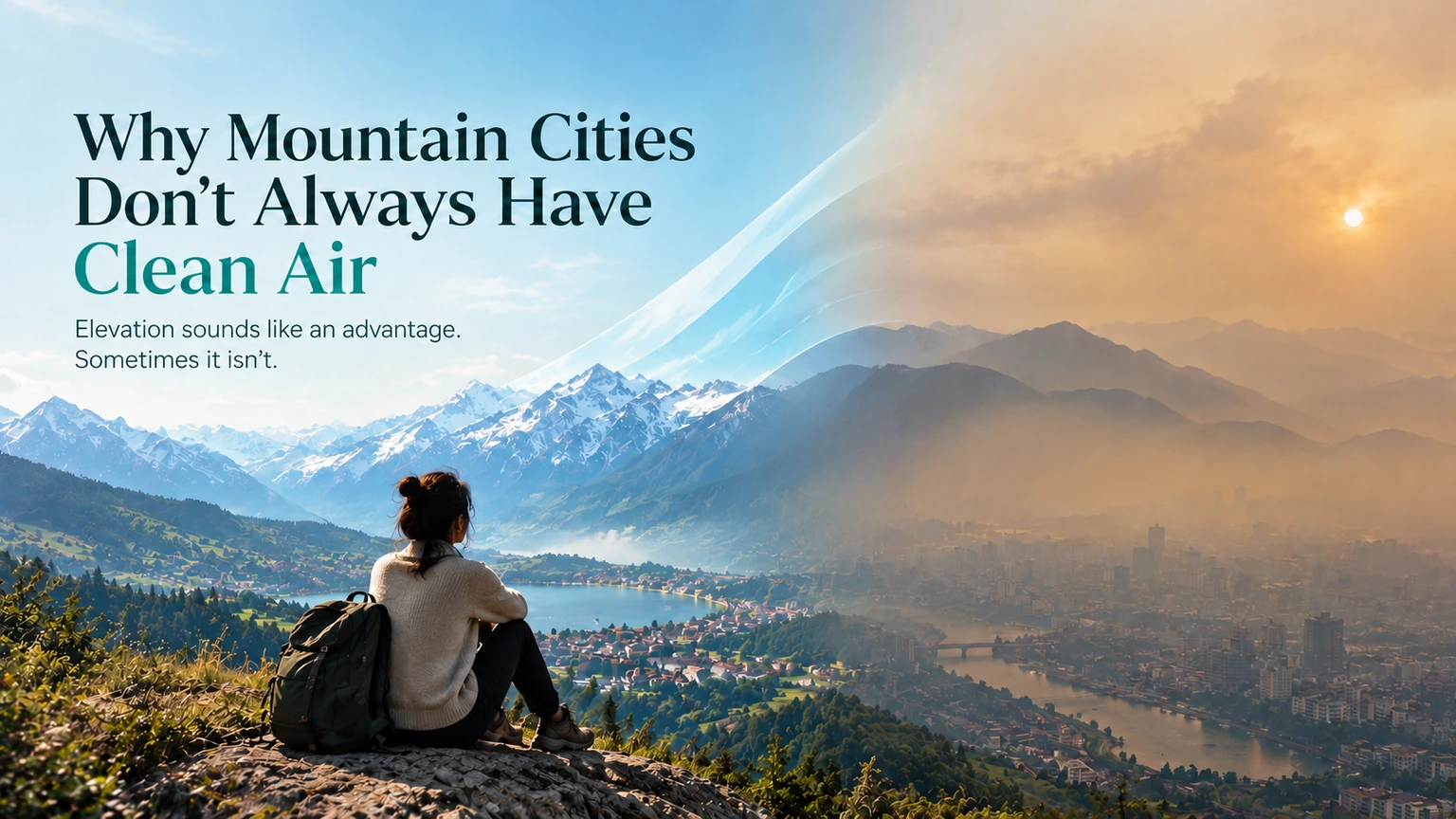
Elevation sounds like an advantage. Sometimes it isn't. Some mountain cities can have surprisingly poor air quality, and in certain conditions, the mountains themselves can make the problem worse.
Elevation sounds like an advantage. Sometimes it isn't.
There is something almost instinctive about the idea of mountain air.
Go higher, leave the traffic behind, breathe colder air, look out over the valley.
It feels like the recipe for cleaner skies.
But some mountain cities can have surprisingly poor air quality, and in certain conditions, the mountains themselves can make the problem worse.
The reason has less to do with how high a city sits and more to do with what happens to the air around it.
Higher doesn't automatically mean cleaner
At first, the logic seems straightforward.
Cities at higher elevations are often farther from major industrial centres, surrounded by vegetation, and exposed to fewer of the pollution sources found in dense lowland cities.
But elevation alone doesn't determine air quality.
Air pollution is constantly moving.
Smoke, dust, nitrogen dioxide, ozone and tiny particulate matter can travel hundreds or even thousands of kilometres before reaching a city. Once they arrive, local geography and weather determine whether those pollutants disperse or stay trapped.
And mountains can play a surprisingly important role.
The valley problem
Some of the world's most beautiful cities are built in valleys or basins.
That creates a natural barrier around the city.
Under normal conditions, warm air near the surface rises and mixes with cooler air above it, helping pollutants disperse.
But sometimes the atmosphere flips this pattern.
A layer of warmer air can sit above cooler air near the ground. This is called a temperature inversion.
Instead of rising, the colder air stays trapped beneath the warmer layer.
And so does everything inside it.
Cars continue producing exhaust. Homes produce smoke. Businesses and industries continue operating.
But the pollution has nowhere to go.
The result can be a layer of dirty air sitting over a city even when the surrounding mountains look perfectly clear.
Mountains can trap pollution
This is one reason geography matters so much.
A city surrounded by mountains may have less natural ventilation than a city sitting on an open plain.
Wind has fewer easy pathways through complex terrain. Valleys can channel air in particular directions, while surrounding slopes can limit vertical mixing.
When conditions are favourable, this isn't necessarily a problem.
When the atmosphere is stable, however, pollutants can accumulate.
This has been observed in mountain and basin cities around the world, from the Himalayas to the Andes and the Rockies.
The same mountains that create spectacular views can sometimes act like walls around the air below.
Then there is wildfire smoke
There is another problem that has become increasingly difficult to ignore: mountain air can be polluted by something happening hundreds of kilometres away.
Wildfires don't respect city boundaries.
Smoke can travel vast distances through the atmosphere, carrying fine particulate matter with it.
That means a city with relatively little local pollution can suddenly experience unhealthy air because of a fire burning somewhere else.
This has become particularly visible across parts of North America during major wildfire seasons.
Cities far from the actual flames can see hazy skies and sharp increases in fine particulate pollution.
And mountains don't necessarily protect them.
In some cases, terrain and atmospheric conditions can influence where that smoke settles or how long it remains.
The source of the pollution may be nowhere near the city.
But the air still arrives.
Altitude can change the pollution story – just not always in the way we expect
There is also a subtle distinction between altitude and air quality.
At higher elevations, the atmosphere is thinner. But that doesn't mean the air automatically contains fewer pollutants.
Pollution concentrations depend on emissions, weather, atmospheric mixing, chemical reactions and transport — not simply on how many metres above sea level a city sits.
In fact, some pollutants can become more complicated at altitude because sunlight, temperature and atmospheric chemistry influence how they behave.
Ozone is a good example.
Unlike particulate matter, ozone isn't simply emitted directly from a tailpipe. It forms through chemical reactions involving other pollutants and sunlight.
So a mountain city can have relatively low local emissions and still experience elevated ozone under the right conditions.
Kathmandu shows why geography matters
Kathmandu is a striking example of how geography can complicate the clean-air equation.
The city sits inside the Kathmandu Valley, surrounded by hills and mountains.
That setting gives the city its distinctive landscape, but it can also limit the movement of polluted air.
Vehicle emissions, construction dust, household emissions and pollution transported into the valley can accumulate when atmospheric conditions prevent sufficient ventilation.
The result is a city where being surrounded by mountains doesn't guarantee clear air.
Sometimes the opposite can happen.
The same thing can happen in the Andes
The Andes provide another reminder that beautiful geography doesn't equal clean air.
Cities such as Santiago and Bogotá sit within or alongside complex mountain terrain, where topography interacts with weather, traffic and emissions.
Santiago, for example, is surrounded by mountains and has experienced serious air-quality problems, particularly when atmospheric conditions limit dispersion.
The mountains aren't creating the pollution.
But they can influence what happens after the pollution is produced.
That distinction matters.
A mountain city can also receive pollution from somewhere else
Air doesn't stop at city limits.
This is perhaps the most important thing to understand about air quality.
A city's AQI is not necessarily a measurement of pollution produced by that city.
Fine particulate matter can travel long distances.
Smoke can cross borders.
Dust can travel between regions.
Industrial emissions can move with prevailing winds.
Wildfire plumes can cross entire countries.
So when a mountain city records poor air quality, looking only at what is happening inside the city can miss part of the story.
The air arriving today may have started somewhere else.
So, are mountain cities cleaner?
Sometimes.
But “mountain city” is not an air-quality category.
A high-altitude city with low emissions, strong winds and good ventilation may have excellent air.
A city at similar elevation surrounded by steep terrain, heavy traffic and frequent temperature inversions may have much worse air.
And a city with relatively clean local emissions can still experience pollution episodes caused by wildfire smoke, dust or regional transport.
Elevation is one piece of the puzzle.
It isn't the answer.
The bigger lesson: geography shapes pollution, but doesn't determine it
When we look at an AQI map, it is tempting to think of pollution as something that belongs to individual cities.
But the atmosphere doesn't work that way.
A city is part of a much larger system.
Its geography determines how easily pollution can move.
Weather determines how quickly it disperses.
Local emissions determine what enters the atmosphere.
And pollution from far beyond the city can change the picture again.
That is why two cities at almost the same elevation can have completely different air-quality stories.
And why a city surrounded by some of the world's most spectacular mountains can still have days when the best view is the one you can't see.
Clean air isn't simply about being higher.
It's about what the atmosphere is able or unable to carry away.
Geography shapes pollution, but doesn't determine it. See how your city's air is doing right now.
Check Your City's AQI