The celebrations may have ended in a night, but across India, the air told a different story. From Pune to Patna and Bengaluru to Delhi, the days after Diwali revealed a pollution problem that stretches far beyond one city.
Diwali looks different across India.
In some cities, the celebrations unfold against relatively clear skies. In others, fireworks fill the streets with smoke, neighbourhoods disappear behind a haze and the morning after begins with a familiar ritual: checking the AQI.
But what happens when the celebrations are over?
Does the pollution disappear with the smoke? Do all Indian cities experience the same deterioration? And why can a city that had relatively clean air before Diwali suddenly find itself dealing with much higher pollution levels afterwards?
The air quality data from Diwali 2026 offers an interesting answer.
Delhi may receive much of the attention every winter, but it was far from the only Indian city experiencing a post-Diwali pollution spike.
From the western coast to eastern India, and from the southern metros to smaller inland cities, the festival left behind a much wider air-quality story.
It wasn't just Delhi: The post-Diwali picture across India
One of the most revealing findings from this year's data is how widespread the deterioration was.
An analysis of Central Pollution Control Board (CPCB) readings for 278 Indian cities, comparing November 8 (Diwali) with November 9 (the following day), found that 213 cities recorded an increase in AQI.
The number of cities reporting moderate or worse air quality also increased from 191 on Diwali to 246 the following day.
This is important because it challenges the idea that post-Diwali pollution is primarily a Delhi problem.
Delhi's pollution levels were already extremely high, but several other cities experienced sharp increases from their pre-festival conditions.
Some of the most striking changes included:
| City | AQI on Diwali | AQI the following day |
|---|---|---|
| Pune | 163 | 292 |
| Pimpri-Chinchwad | 202 | 301 |
| Bengaluru | 70 | 133 |
| Chennai | 138 | 199 |
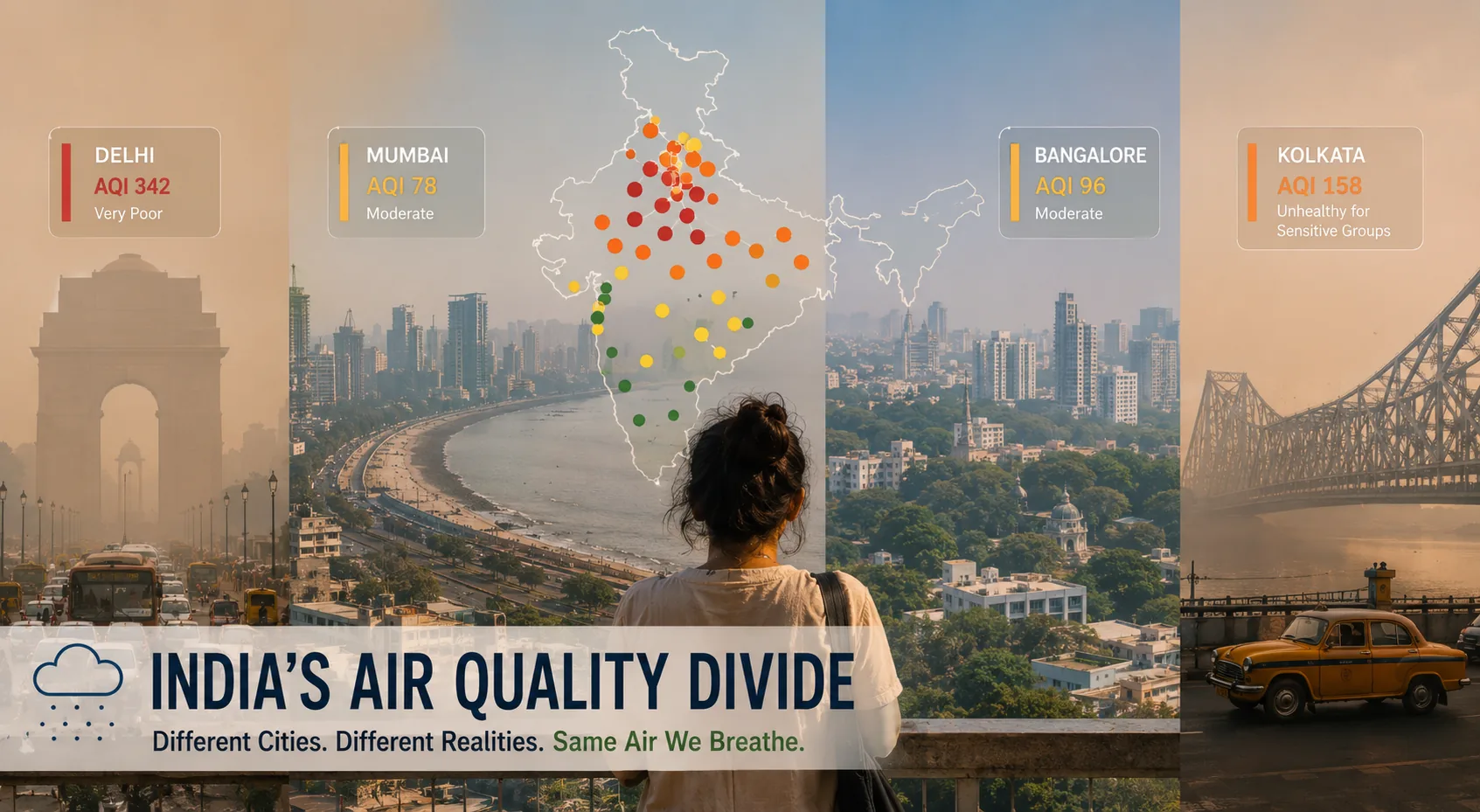
| Mumbai | 132 | 172 |
| Hyderabad | 84 | 119 |
Source: CPCB city-level AQI bulletins for November 8 and 9, 2026, as compiled in post-Diwali reporting. These are daily city readings, not annual averages.
Pune recorded one of the largest increases, with its AQI rising by 129 points in a day. Pimpri-Chinchwad crossed into the very poor category, while Bengaluru moved from satisfactory to moderate.
The pattern was not uniform. Delhi and Kolkata recorded lower readings on November 9 than on Diwali day, illustrating how different local conditions can produce different outcomes.
The takeaway is not that every city became equally polluted. It is that the post-Diwali deterioration was geographically widespread.
Why did some cities experience a much bigger spike?
If Diwali is celebrated across the country, why do the air-quality effects vary so significantly?
The answer lies in the combination of emissions and local atmospheric conditions.
Fireworks release fine particles, larger particulate matter and a mixture of gases and chemical compounds. The amount of pollution produced depends on the scale and duration of fireworks activity, the types of fireworks used and how widely they are distributed.
But the concentration measured by an air-quality monitor also depends on what happens after those pollutants enter the atmosphere.
Weather makes a difference
Wind can disperse pollutants, while weak winds may allow them to accumulate near the ground. Rain can remove some airborne particles. Temperature inversions and poor atmospheric mixing can make it harder for pollutants to disperse.
This means two cities experiencing similar fireworks activity can record very different AQI readings.
Geography matters
Coastal and inland cities experience different weather and circulation patterns.
For example, Mumbai's coastal location can expose it to sea breezes that influence pollutant dispersion. Inland cities such as Pune and Nagpur experience different atmospheric conditions.
However, being a coastal city does not guarantee clean air. Local emissions, wind direction and weather patterns still matter.
The pollution already present matters
A city entering Diwali with elevated pollution may experience a different outcome from one starting with relatively clean air.
An increase of 100 AQI points in a city that begins at 70 tells a different story from a similar increase in a city already above 300.
Both deserve attention, but the starting conditions and resulting exposure are not the same.
India's post-Diwali pollution map is more complicated than we think
Consider the differences across regions.
Northern India: A festival coinciding with the winter pollution season
Cities across the Indo-Gangetic Plain, including Delhi, Lucknow and Patna, face additional seasonal challenges.
As temperatures fall, weaker atmospheric mixing and temperature inversions can contribute to pollution accumulating close to the ground.
In parts of northern India, agricultural residue burning, transport emissions, industrial activity and construction dust can add to the pollution burden.
This means Diwali-related emissions arrive at a time when several other pollution sources are already active.
Western India: The contrast between coastal and inland cities
This year's readings in Maharashtra were particularly interesting.
Mumbai remained in the moderate category, while Pune and Pimpri-Chinchwad experienced much sharper deterioration.
On November 9, Pimpri-Chinchwad recorded an AQI of 301 and Pune recorded 288, compared with 172 in Mumbai.
The difference illustrates why it is misleading to use one city's air quality as a representation of an entire state.
Even cities within the same region can experience very different pollution conditions.
Southern India: Cleaner starting air doesn't mean no pollution spike
Bengaluru and Chennai also recorded noticeable increases.
Bengaluru's AQI rose from 70 to 133 between November 8 and 9. Chennai's reading increased from 138 to 199.
These cities started from different pollution levels, but both experienced a deterioration after the festival.
This is an important distinction. A city does not need to be among India's most polluted to experience a significant post-Diwali air-quality event.
Eastern India: The pollution story extends beyond the major metros
Cities in eastern India also experienced significant changes.
Patna's AQI more than doubled, rising from 111 to 233 in the post-Diwali comparison.
Bhubaneswar recorded a substantial increase during the festival period, while Kolkata followed a different pattern.
The variation reinforces the importance of examining local readings rather than assuming that the same pollution trend applies everywhere.
The smoke may be temporary. The pollution problem isn't.
Fireworks are one contributor to post-Diwali pollution, but they are not the only reason air quality can remain poor afterwards.
Across India, everyday emissions continue long after the celebrations end.
Vehicles release pollutants during daily commutes. Construction activity generates dust. Industrial operations continue. Waste burning and other combustion sources add to the overall pollution burden.
In northern India, the transition into winter can make the situation more difficult.
This is particularly visible in Delhi, where pollution was already elevated before Diwali.
A November 2026 analysis by the Centre for Science and Environment found that Delhi's average PM2.5 concentration during the week preceding Diwali was 236 micrograms per cubic metre, almost double the corresponding 2025 figure.
The analysis also highlighted the contribution of regional pollution transport and everyday local emissions.
The point is important for the wider Indian story: the festival can add to an existing pollution problem, but the underlying emissions do not disappear when the fireworks stop.
Different cities have different sources and seasonal patterns. A northern city's winter smog cannot automatically explain pollution in a coastal or southern city.
Understanding those differences is essential to addressing the problem.
How long does post-Diwali pollution actually last?
There is no fixed number of days after which Diwali-related pollution disappears.
In some places, stronger winds or rainfall can help improve conditions relatively quickly. In others, weak winds and continued emissions can keep pollution levels elevated.
It is also important to distinguish between a short-lived spike in particulate matter and a longer period of poor air quality.
The first may be strongly influenced by fireworks. The second can reflect a combination of traffic, industrial activity, dust, regional pollution transport and weather.
A 2024 study published in Discover Environment, which examined air-quality variations across 71 monitoring stations in more than 15 Indian states, found that particulate matter concentrations were significantly higher during the post-Diwali period than the pre-Diwali period in several of the years studied.
This suggests that the impact can extend beyond the night of the festival.
However, the duration and intensity vary by location and year. There is no single national recovery timeline.
The best way to understand what happens is to follow the air-quality trend over several days rather than relying on a single morning's reading.
What does this mean for people living in Indian cities?
For people, the effects are not limited to a number on an AQI dashboard.
A rise in particulate pollution can mean increased exposure, particularly for children, older adults and people with existing respiratory or cardiovascular conditions.
Fine particulate matter such as PM2.5 is especially concerning because it can travel deep into the lungs and is associated with a range of health effects.
During periods of poor air quality, checking local conditions can help people make more informed decisions about outdoor activity.
The next Diwali shouldn't be the only time we talk about air quality
The data from Diwali 2026 reveals something worth paying attention to.
Air pollution after the festival was not confined to Delhi. Cities across different regions experienced deterioration, and some of the sharpest increases occurred in places that are not usually at the centre of India's winter pollution conversation.
But this should not become an annual discussion that begins with fireworks and ends a few days later.
India's air-quality challenges are year-round, even though their intensity and sources change with geography and season.
Cleaner transport, industrial emission controls, construction-dust management, better waste practices and more effective monitoring all need consistent attention.
It is equally important to understand local pollution patterns. A national average cannot explain what is happening on an individual street, near a school or around a residential neighbourhood.
Diwali gives us a visible reminder of how quickly air quality can change.
What happens afterwards should remind us that cleaner air requires much more than a few days of attention.
The celebrations happen across India. So should the conversation about the air we breathe.
The celebrations happen across India. So should the conversation about the air. Check your city's live AQI and see how it's trending this week.
Check Your City's AQI