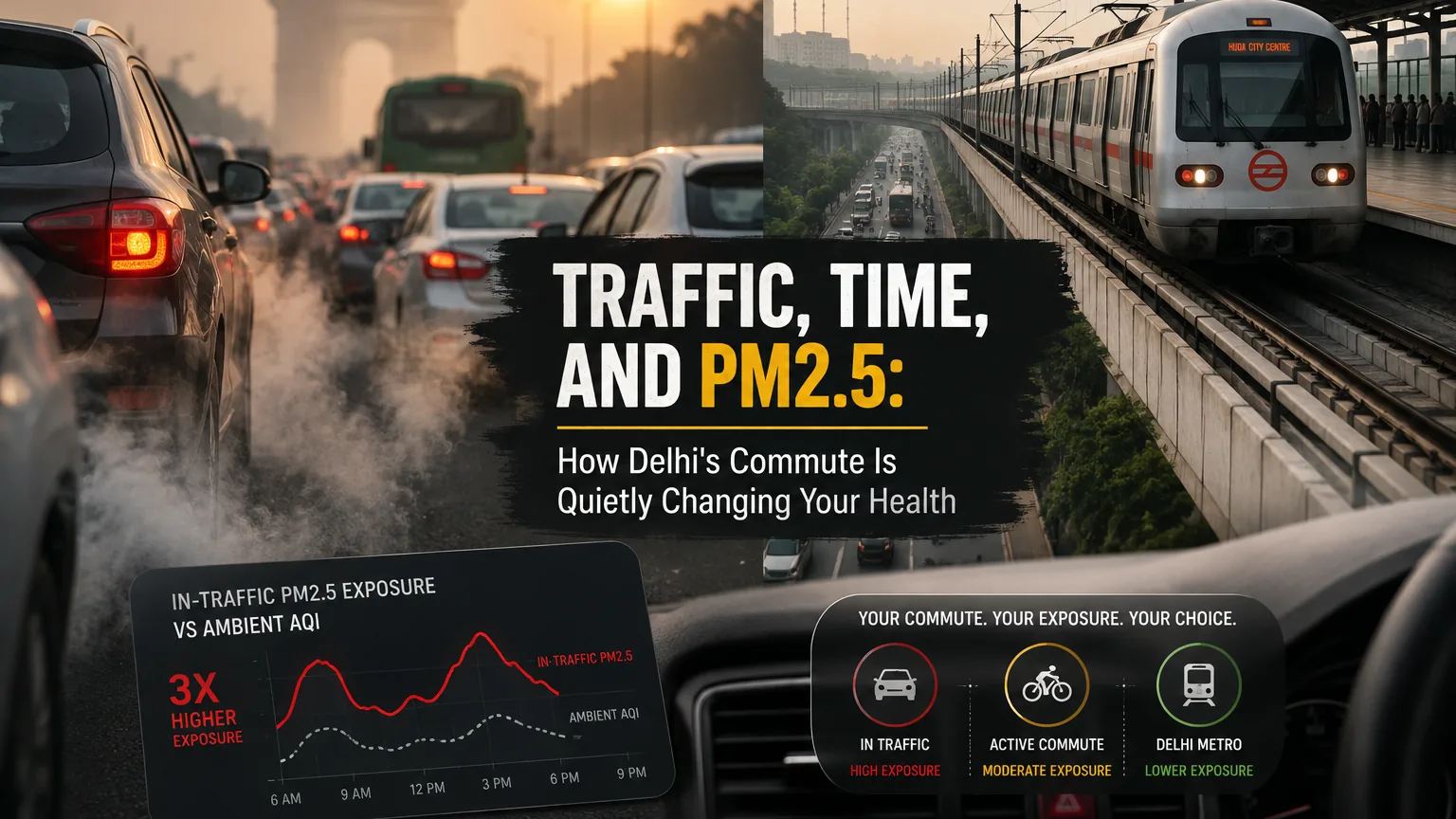
You've checked the Delhi AQI today. It says 180 — "Unhealthy." You figure it's manageable. You get in your car or hop on a bus and navigate the morning gridlock. What you probably don't know is that your actual PM2.5 exposure during those 45 minutes in traffic was likely 2 to 3 times higher than what the monitoring station reported.
Traffic environments are among the most polluted spaces a person can occupy, and most Delhi commuters spend 60 to 90 minutes in them every day.
The ambient AQI — the number you see on the dashboard — is typically measured at fixed monitoring stations positioned away from direct traffic influence. It reflects the general air quality of a neighbourhood or district. What it doesn't capture is the microenvironment of a road, particularly a congested one.
The In-Traffic Pollution Premium
When you're in a car or bus on Delhi roads during peak hours, you're in a corridor of concentrated emissions. Every vehicle around you is exhausting combustion byproducts directly at road level, in dense concentration. Wind dispersion is limited by the canyon effect of buildings and by slow traffic movement.
Studies measuring in-vehicle PM2.5 in Indian cities have found that concentrations inside a car with windows closed and AC on "fresh air" mode (drawing outside air) can be 2-4x the ambient monitoring value. With windows open, the figure can be higher. On a road like Mathura Road, Ring Road, or the NH-8 stretch through Gurgaon during peak hours, in-vehicle PM2.5 readings can exceed 400-600 µg/m³ on a day when the city's official AQI reads 200.
The Metro Comparison
This is where the data gets interesting for commuters who have a choice. Delhi Metro trains, which run in mostly enclosed or elevated corridors away from direct road-level exhaust, offer substantially better in-transit air quality than road transport.
Platform environments, particularly at underground stations, do have elevated CO₂ and some particulate levels due to brake dust and crowd density. But the sustained PM2.5 exposure during a Metro ride is demonstrably lower than equivalent time in a car or bus on congested roads.
For the morning commute — when inversion conditions often mean peak pollution — the Metro's air quality advantage is at its largest.
Active Commuters: The Cyclist and Walker Problem
Delhi has a growing community of cyclists and fitness-oriented walkers. The health benefits of physical activity are significant and well-documented. But the trade-off in a high-pollution environment is real.
During exercise, the breathing rate increases 2-4x compared to rest. This means the rate of PM2.5 intake scales proportionally. A 30-minute cycle commute on a 200 AQI morning generates a meaningfully higher PM2.5 lung dose than 30 minutes sitting in a Metro car.
The calculus isn't straightforward — the cardiovascular benefits of cycling don't disappear because of pollution, and the net health equation of active vs sedentary transport is context dependent. But it does suggest that the timing of outdoor exercise matters more than most people realise.
The Clean Hours Today widget on the dashboard shows the hourly AQI pattern for a given city. For Delhi, the pattern in winter is reliable: peak pollution in early morning and evening, relatively lower levels in the 10am-2pm window on days without inversions. That's the cycling window, if you have flexibility.
What Helps in a Car
If you drive in Delhi, several practical steps reduce your exposure:
- Air recirculation mode. Switching your AC from "fresh air" to "recirculation" (the button with the curved arrow and a car icon) stops drawing outside air and recirculates the filtered interior air. On high-AQI days, this is the single most effective step available in-car.
- Cabin air filter maintenance. Most cars have a cabin air filter that cleans air drawn from outside. These filters have limited lifespans — often 15,000-20,000 km or annually — and an overdue filter can accumulate enough particulate to release rather than filter. Regular replacement matters more in high-AQI cities.
- HEPA cabin upgrades. Some car manufacturers and aftermarket suppliers offer HEPA-grade cabin filters for certain vehicle models. In Delhi, this is a worthwhile upgrade.
- Timing. If any flexibility exists in departure time, leaving before 7:30am or after 10am avoids the peak congestion period that generates the highest in-traffic pollution.
The Longer Picture
The cumulative health impact of two to three hours of daily in-traffic exposure in Delhi over years is a number nobody has fully calculated, because it sits in the gap between ambient monitoring data (which undercounts) and medical record analysis (which can't isolate this specific exposure source).
But the epidemiological data on occupational traffic exposure — for traffic police, auto-rickshaw drivers, and bus drivers who spend their entire working day on Delhi roads — gives an uncomfortable preview. These populations show disproportionate rates of respiratory disease, cardiovascular events, and reduced lung function at younger ages than comparable populations in lower-traffic roles.
The commuter's exposure is less than the traffic police officer's. It's not zero.
Before your commute tomorrow, check Delhi's current AQI and conditions so you can make a better-informed decision about your route, timing, and protection.
Check Delhi's AQI