For many children, going outside is becoming more than a question of free time. In cities struggling with air pollution, it can also become a question of whether the air is safe enough to play in.
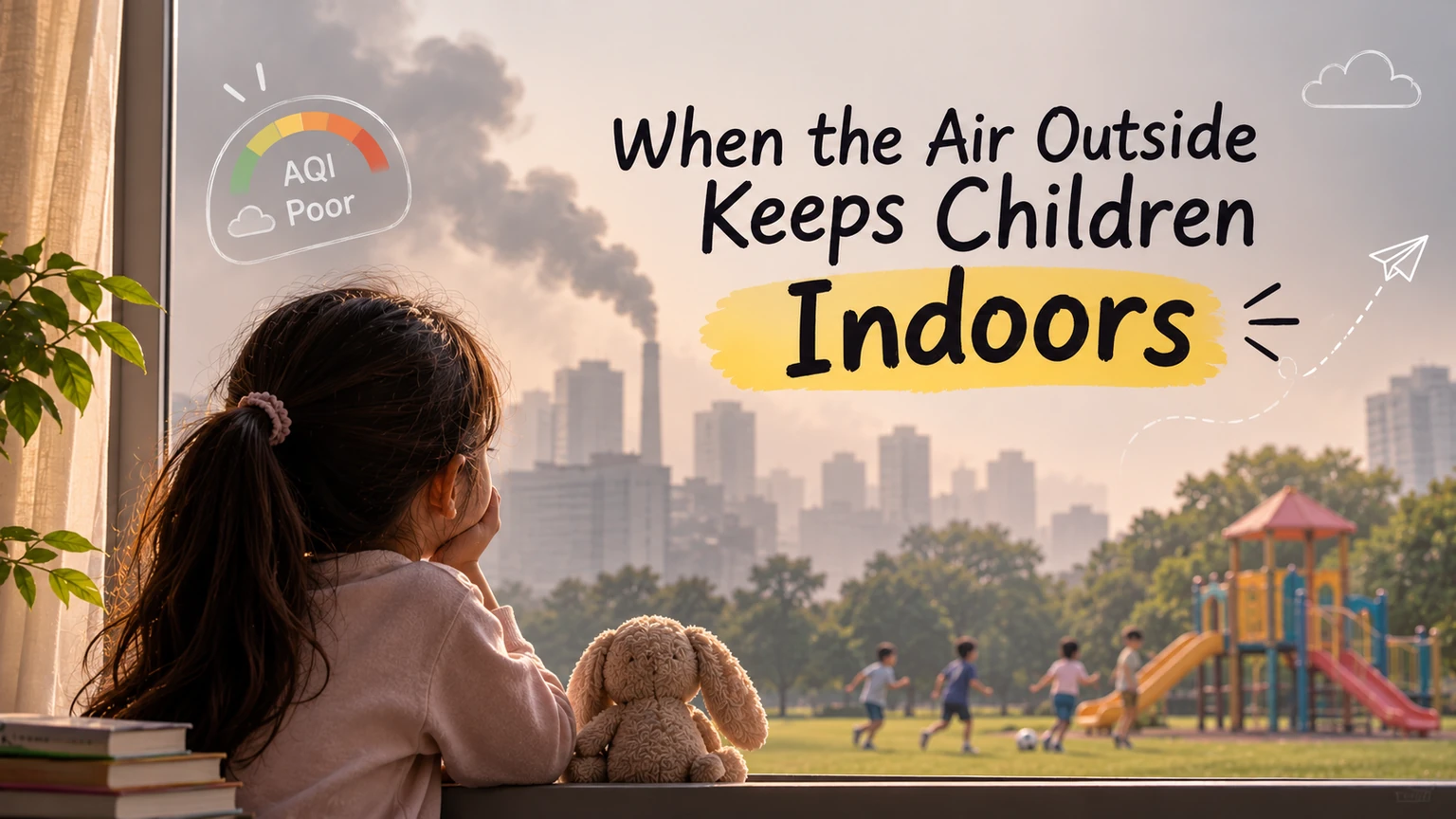
A child looks out of the window.
There is a playground downstairs, a bicycle waiting near the door and a few friends already playing outside.
But the air quality reading on a parent's phone tells a different story.
The outdoor plans change. The windows stay closed. The afternoon is spent indoors.
For children growing up in heavily polluted cities, this is not necessarily an unusual situation. Air quality can influence something as ordinary as playing outside, walking to school or participating in a sports activity.
We often discuss air pollution through statistics: AQI readings, particulate matter concentrations, emissions and pollution alerts.
But there is another way to understand its impact.
Look at what happens to childhood when the outdoors becomes a place parents increasingly have to think twice about.
When playing outside becomes a calculated decision
Outdoor play has traditionally been one of the simplest parts of childhood.
Children run, cycle, play sports, explore their neighbourhoods and spend time with friends. These activities provide opportunities for physical movement, social interaction and learning about the world.
But in cities experiencing recurring pollution episodes, outdoor activities can become dependent on air quality.
Parents may check pollution levels before sending children to a park. Schools may reconsider outdoor sports during severe pollution events. Families may avoid busy roads, construction areas or playgrounds close to major traffic corridors.
The decision is often not as simple as staying indoors or going outside.
Pollution levels can change throughout the day. Conditions can vary between neighbourhoods. A park away from heavy traffic may have a different exposure profile from a playground beside a congested road.
And when poor air quality persists for days or weeks, avoiding outdoor activity becomes increasingly difficult to manage.
The outdoors hasn't disappeared from children's lives. But in some places, access to it is becoming conditional.
Why children are particularly vulnerable to polluted air
Air pollution affects everyone, but children face some specific risks.
Their lungs are still developing, and they breathe more air relative to their body weight than adults. They also tend to be physically active, which can increase the amount of air they inhale during outdoor play.
Fine particulate matter, particularly PM2.5, is a major concern because these tiny particles can travel deep into the respiratory system.
Exposure to air pollution during childhood has been associated with respiratory problems, reduced lung development and an increased risk of asthma-related effects.
The World Health Organization identifies air pollution as a significant environmental risk to children's health.
This makes the issue particularly important in cities where pollution is not limited to occasional episodes but remains a recurring part of everyday life.
A child may spend only a few hours outside each day, but repeated exposure over months and years matters.
And unlike adults, children have very little control over the environments they grow up in.
The playground is not the same everywhere
Consider two children.
One grows up in a neighbourhood with tree-lined streets, low traffic, accessible parks and relatively clean air.
The other lives near a major road, surrounded by construction activity and exposed to frequent pollution episodes.
Both may have the same school hours and the same desire to play outside.
But their opportunities are not equal.
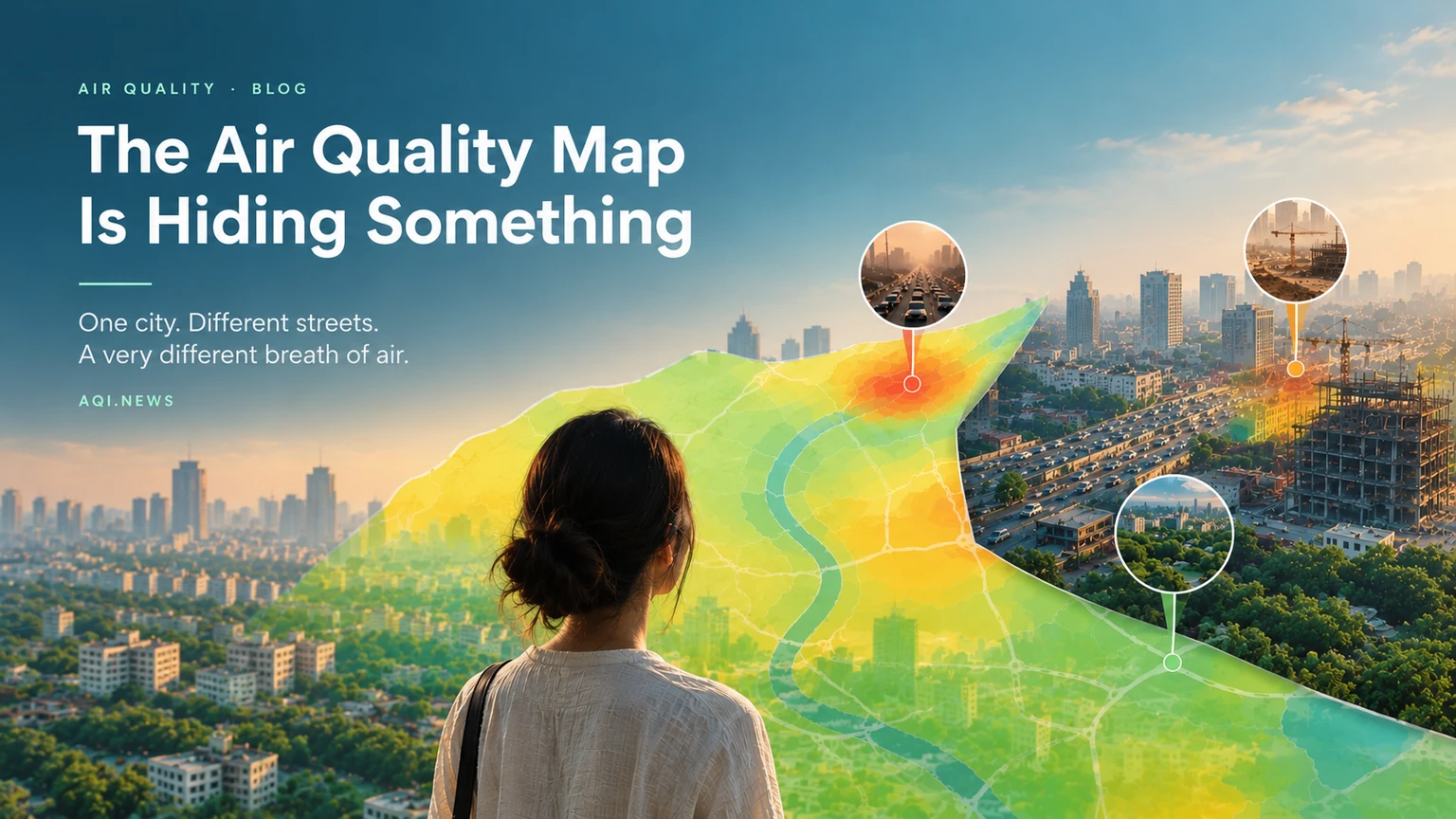
Even within the same city, air pollution can vary considerably across locations. Traffic corridors, industrial areas, construction zones and densely populated neighbourhoods can experience different pollution levels.
This means that a city's overall AQI reading does not necessarily describe the air a child breathes on the way to school or while playing in a nearby park.
The location of schools and playgrounds matters. So does the distance from major emission sources, street design, vegetation and the way buildings influence airflow.
Clean air is not simply an environmental luxury. It is part of whether children can use the spaces around them.
The invisible cost of staying indoors
When outdoor air quality becomes a concern, keeping children indoors can seem like the safest immediate response.
But this creates another challenge.
Outdoor activity is important for physical health, social development and well-being. Regular movement helps children build strength, coordination and healthy habits.
Time outdoors also gives children opportunities to explore nature, develop independence and experience environments beyond classrooms and screens.
Research has associated outdoor time with several positive health outcomes. Studies have also found that spending time outdoors can help reduce the risk of developing myopia in children.
This creates a difficult contradiction.
The same outdoor environment that supports children's development can also expose them to harmful pollutants.
Keeping children indoors indefinitely is not a long-term solution. Neither is ignoring air pollution because outdoor activity is beneficial.
The real objective should be to make outdoor spaces healthier.
When schools have to rethink outdoor time
Schools are among the most important places where this issue becomes visible.
Physical education, sports days, playground breaks and outdoor activities are built into the school experience.
But when pollution levels rise, schools may have to reconsider these activities.
Some institutions monitor local air quality and adjust outdoor schedules based on conditions. Others move activities indoors during particularly polluted periods.
For schools in cities with recurring pollution episodes, this can become a regular operational challenge.
The difficulty is that schools cannot rely on a single citywide AQI number to make every decision.
Air quality can differ between the school campus, nearby roads and surrounding neighbourhoods. Conditions can also change during the school day.
Access to reliable local monitoring, suitable indoor alternatives and clear guidelines can help schools make better-informed decisions.
But ultimately, schools should not have to keep moving playground activities indoors because the surrounding environment is consistently polluted.
Why the solution cannot be to keep children inside
Air purifiers, closed windows and indoor activities can help reduce exposure in certain circumstances.
But they do not address the underlying source of the problem.
If vehicles, industrial facilities, construction activity, waste burning and other sources continue releasing pollutants into the atmosphere, children will continue encountering polluted air when they step outside.
The solution needs to begin beyond the walls of individual homes.
Cities need cleaner transport systems, better control of industrial emissions, effective construction-dust management and improved waste practices.
Schools and playgrounds should be planned away from major pollution sources wherever possible, with appropriate buffers and green spaces.
Urban trees, shaded walking routes and well-designed parks can make neighbourhoods more comfortable, although greenery alone cannot compensate for high emissions.
Air-quality monitoring also needs to become more localised.
Knowing the conditions across a city is useful. Knowing what the air is like around a school, playground or residential street can be even more relevant to everyday decisions.
The goal should not be to teach children how to avoid polluted cities.
It should be to create cities where children do not have to avoid the outdoors.
A generation growing up with air-quality alerts
For many adults, childhood memories of the outdoors involve spontaneous afternoons, neighbourhood games and long hours spent outside without much planning.
For some children today, outdoor time comes with an additional consideration: checking the air first.
This does not mean every child is spending less time outdoors, or that air pollution is the only reason childhood routines have changed.
But in heavily polluted regions, it is an increasingly important part of the conversation.
And the consequences extend beyond the immediate discomfort of a polluted afternoon.
When outdoor activities are repeatedly restricted, children may lose opportunities for movement, exploration and connection with their surroundings.
The problem is not simply that children are spending more time indoors.
It is that the quality of the environment outside may be limiting their freedom to go out.
Every child deserves an outdoor childhood
A playground should be a place where children think about which game to play, not whether the air is suitable for running.
A school sports day should be remembered for the races, the excitement and the cheering — not for the pollution reading that forced it indoors.
And a walk to the neighbourhood park should not require a family to first evaluate the atmosphere.
Air pollution is often discussed as a problem of emissions, infrastructure and public health. It is all of those things.
But it is also a question of what kind of childhood our cities make possible.
Children cannot choose where they are born, which roads surround their homes or what enters the air they breathe.
The responsibility lies with the environments we create around them.
Because growing up should mean discovering the world outside, not learning to stay away from it.
Before the next trip to the park, check the air first. See live AQI and the cleaner hours of the day for your city.
Check Your City's AQI