From London to Bogotá, cities are experimenting with a radical idea: what if streets were designed around people instead of cars?
Imagine walking down a road that is usually packed with traffic.
No engines idling at the intersection. No constant honking. No queue of cars stretching towards the next signal.
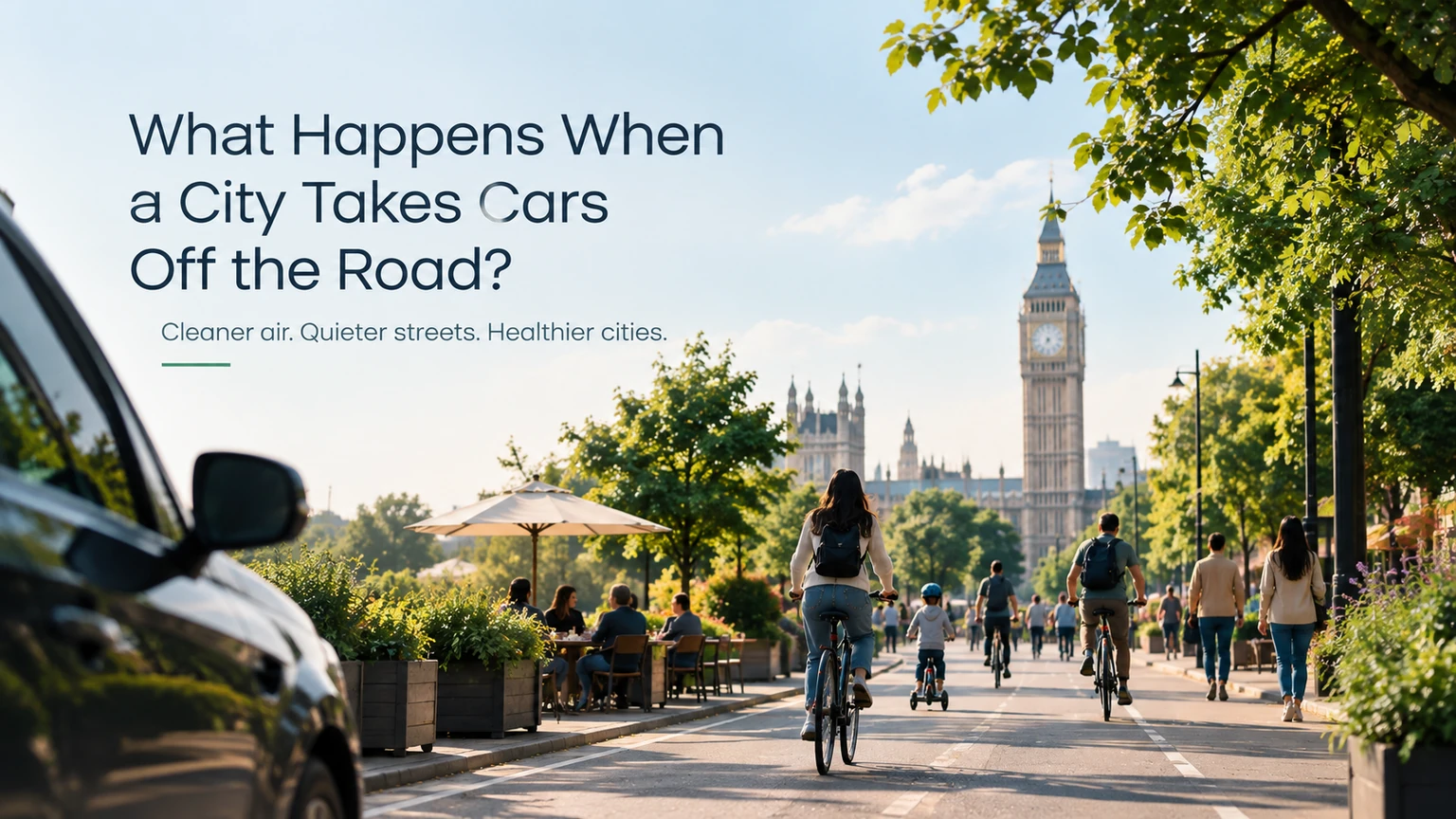
Instead, people are cycling down the middle of the street. Children are learning to ride bicycles. Cafés have more space for outdoor seating. Someone who normally hurries past the road is stopping to talk to a neighbour.
The road hasn't disappeared.
The cars have.
For a few hours, the street has become something different.
This isn't an imaginary city. Variations of this experiment are already happening around the world, from Bogotá's weekly open streets to London's efforts to reduce pollution from vehicles.
But removing cars from a road raises a bigger question than whether the street becomes quieter.
Does taking cars off the road actually make a city cleaner, healthier and easier to live in – or does the traffic simply move somewhere else?
The answer depends on what a city changes, how it does it, and what happens next.
The first thing that changes is the air
Road traffic produces more than exhaust fumes.
Combustion engines emit pollutants such as nitrogen oxides and fine particles. Vehicles also contribute to pollution through tyre and brake wear, while traffic can stir dust back into the air.
Reducing the number of vehicles travelling along a road can reduce some of these emissions, particularly when the change is sustained.
But the relationship between fewer cars and cleaner air isn't always straightforward.
Pollution levels depend on the number and type of vehicles, traffic speeds, congestion, wind, weather and pollution arriving from elsewhere. A road that becomes quieter for an afternoon may experience a noticeable local change without producing a dramatic improvement in the city's overall AQI.
A temporary road closure also cannot eliminate emissions from power generation, industry, construction, household fuels or other sources.
That doesn't make car-free streets ineffective. It means the scale of the intervention matters.
A few hours without traffic can demonstrate what a street feels like when cars aren't dominant. A permanent reduction in car dependence can go further by changing how a city moves every day.
London: Cleaner vehicles, fewer emissions
London didn't simply ban cars from the city.
Instead, it developed a combination of policies designed to discourage unnecessary driving, manage congestion and reduce emissions from the vehicles that remain on the road.
Its Congestion Charge, introduced in 2003, charges drivers to enter a designated central area. The Ultra Low Emission Zone, or ULEZ, uses vehicle-emissions standards to encourage drivers to use cleaner vehicles or pay a charge if their vehicles don't meet the requirements.
The distinction is important: the congestion charge targets traffic entering a zone, while ULEZ targets vehicle emissions standards.
The results offer a useful lesson in what these policies can achieve.
According to the Greater London Authority's evaluation of the London-wide ULEZ expansion, roadside nitrogen dioxide concentrations across London in 2024 were estimated to be 27% lower than they would have been without the ULEZ and its expansions.
That is a modelled comparison against an estimated alternative scenario, not a claim that pollution fell by 27% everywhere solely because of one policy.
The report also estimated lower emissions of nitrogen oxides and exhaust PM2.5 from cars and vans than would have occurred without the relevant ULEZ measures.
London's experience illustrates something important: cities can improve air quality without eliminating every car. Changing which vehicles can circulate, how much driving costs and what transport alternatives are available can make a measurable difference.
But cleaner vehicles are only part of the story.
If the objective is to reduce congestion, noise, road danger and the amount of public space devoted to driving, a city may need to go further than replacing older cars with newer ones.
Bogotá: What if the street belonged to everyone?
In Bogotá, Colombia, the transformation takes a different form.
Every Sunday and public holiday, the city's Ciclovía programme closes major roads to motor traffic and opens them to people walking, cycling, running and skating.
The programme began in 1974 and has grown into one of the world's best-known open-streets initiatives.
Today, Bogotá provides more than 120 kilometres of connected routes for the programme, depending on the published route network and event configuration.
For several hours, roads normally used by cars become public spaces for recreation and physical activity.
Families cycle together. Runners use streets that would usually be dominated by vehicles. Vendors and community activities bring life to the routes.
The interesting part isn't simply that cars are temporarily removed.
It's what the city puts in their place.
A closed road could be nothing more than an inconvenience if people have nowhere else to go. Bogotá's approach creates an alternative use for that space, giving residents a reason to experience the city differently.
It also makes cycling visible and familiar to people who may not otherwise consider it.
Ciclovía does not mean Bogotá has become a car-free city. Motor traffic continues outside the programme's operating hours, and the city still faces transport and air-quality challenges.
Its achievement is different: it has made the idea of streets for people a regular part of urban life.
What happens to traffic when the road closes?
This is where the argument becomes more complicated.
If a city closes one road to cars, drivers may choose a different route. If a neighbourhood restricts through-traffic, some vehicles may travel along its boundary roads instead.
That can create a genuine problem. A street may become quieter while another experiences more traffic, noise or pollution.
But traffic doesn't always relocate in full.
Some people change their departure times. Some combine trips. Others switch to public transport, cycle, walk or decide that a journey isn't necessary after all.
Transport researchers sometimes describe this as traffic evaporation: when road space is reduced, some of the traffic previously using it disappears from the network rather than simply moving elsewhere.
The OECD has reviewed case studies in which concerns about traffic displacement were often greater than the longer-term effects observed.
That doesn't mean displacement never happens. The outcome depends on the location, available alternatives, street design and the scale of the change.
A poorly planned closure can push problems onto neighbouring communities. A well-designed intervention can reduce car journeys while making walking, cycling and public transport more attractive.
The important question isn't just how many cars disappear from one road.
It's how the entire transport system responds.
The benefits extend beyond air pollution
Air quality is one reason to rethink car-dominated streets. It isn't the only one.
Less noise. Fewer passing vehicles can make streets quieter, particularly where traffic volumes fall substantially. This can improve the experience of living, walking and spending time outdoors.
More opportunities for physical activity. Streets that feel safe and comfortable can encourage people to walk and cycle. The World Health Organization identifies active transport and well-designed pedestrian and cycling infrastructure as important contributors to healthier urban environments.
More usable public space. A street is public land, but much of its space may be devoted to moving or storing vehicles. Redesigning it can create room for trees, seating, wider footpaths, cycle lanes and places to gather.
Potentially safer journeys. Reducing vehicle movements and designing roads around slower, safer travel can reduce opportunities for traffic conflicts. The actual safety outcome depends on how the street is redesigned and how different road users are protected.
These benefits can reinforce one another. A safer cycling route may encourage more people to cycle. More people using a street can make it feel more active. Better public transport can make it easier for residents to leave their cars at home.
But none of these outcomes is automatic. A road closure without accessible alternatives may simply make daily life harder for some people.
Who benefits and who might be left behind?
There is a reason car-reduction policies often generate strong reactions.
For someone living near a congested road, fewer vehicles may mean a welcome reduction in noise and pollution.
For someone who relies on a car to reach work, transport a family member with limited mobility or travel from an area with poor public transport, restrictions may feel like a penalty rather than an improvement.
Small businesses may worry about deliveries and customer access. Residents on surrounding roads may fear that traffic will be redirected towards their homes.
These concerns cannot be dismissed by pointing to cleaner-air targets.
A fair transport policy needs to consider who can afford to change vehicles, who has access to reliable public transport, how deliveries are managed and whether people with disabilities can still reach their destinations.
That is why reducing car dependence is not just a question of closing roads.
It is also a question of providing alternatives.
Frequent and affordable buses, reliable rail connections, safe footpaths, protected cycling routes and accessible transport can make it possible for more people to travel without a private vehicle.
Without these investments, restrictions risk placing the greatest burden on people with the fewest choices.
Could the same idea work in other cities?
Bogotá and London demonstrate two different approaches, but their lessons are relevant far beyond those cities.
A city does not have to start by closing every major road or charging every driver.
It might begin with a school street that restricts traffic during drop-off and pick-up times. It could introduce a regular car-free day, redesign a dangerous junction, create a protected cycle route or give buses priority on a congested corridor.
Some changes can be tested temporarily before being made permanent.
The key is to measure what happens.
Do traffic volumes fall across the wider area? Does pollution change at roadside monitors? Are bus journeys faster? Are pedestrians safer? Do neighbouring streets experience more traffic? Can people with different mobility needs still reach essential services?
These questions help distinguish an intervention that merely looks appealing from one that delivers lasting benefits.
Cities also need to consider their starting points. A place with extensive public transport has different options from a city where millions depend on private vehicles because other services are unreliable or unavailable.
There is no universal blueprint for removing cars.
There are, however, many ways to make driving less necessary.
The real experiment isn't about banning cars
It is easy to frame this debate as a choice between two extremes: a city full of cars or a city without any.
Most cities will continue to need motor vehicles for deliveries, emergency services, certain work journeys and people who cannot reasonably use other forms of transport.
The more useful question is how much urban life should depend on private cars and how much space, money and infrastructure cities should devote to making alternatives practical.
London shows that policies targeting vehicle emissions can contribute to cleaner air. Bogotá shows how recurring street closures can turn roads into shared public spaces and make walking and cycling part of a city's culture.
Neither example proves that one intervention can solve every urban problem.
Together, they suggest that cities have more options than simply accepting congestion as inevitable.
Imagine a street where children can cycle safely, buses move reliably, trees have room to grow and people can sit outside without the constant roar of traffic.
The most important change may not be the number of cars removed on a particular day.
It may be the number of people who discover that they no longer need to use one for every journey.
A city doesn't have to eliminate cars to become less car-dependent. It has to make room for a better alternative.
Cities have more options than accepting congestion as inevitable. Compare live air quality across cities and see how yours stacks up.
Compare Cities